 In the East Asia Forum, Kazuhiko Takeuchi, of the United Nations University, cites recent research on what it would take for Japan to meet a 25% emissions reduction target by 2020:
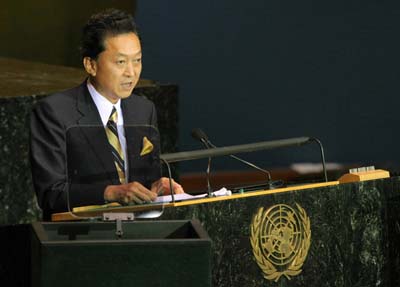
On Monday 7 September, 2009 at the Asahi World Environment Forum, the new Japanese Prime Minister, Yukio Hatoyama, announced that the government would reduce Japan’s greenhouse gas emissions by 25 per cent from 1990 levels, by the year 2020 – this is equivalent to one-third from current levels in just 11 years...
So, how will the goal be achieved? Details are still unclear. The new government has not explained which sectors will have to make the emissions reductions. It announced it would promote green industries, establish a domestic carbon trading market, introduce a global warming measure tax, increase renewable energy by 10 per cent by 2020 through the introduction of a fixed-price feed-in tariff policy, and subsidise photovoltaics for households, environmentally-friendly automobiles, and energy-efficient household appliances.Is that all? For more on Japan's proposed efforts to decarbonize its economy see:
Professor Tetsuo Yuhara, presented what he considered were the required steps to reaching this target at the recent IR3S and University of Tokyo symposium. Reaching the target would require sectoral reductions as follows: industry: 29 per cent, transport: 34 per cent, commercial: 41 per cent, residential: around 50 per cent, energy conversion: 41 per cent. Solar power generation must increase by 55 per cent from current levels requiring photovoltaic cells to be installed in all new houses and some existing houses (600,000 annually). 15 new nuclear power plants must be built and operated with 90 per cent capacity utilisation rate, far above the current rate of 60 per cent. Increased thermal power from both gas power plants and bio-mass mixed combustion would be needed. 90 per cent of sales of new vehicles must be of next generation vehicles. All new houses and existing houses must have heat insulation installed, and mandatory energy conservation standards must be implemented. The price of one ton of CO2 would be 82,000 yen under the new target, compared to 15,000 yen for the previous target of an 8 per cent reduction, or the current price of around 7000 yen.
Pielke, Jr., R.A., 2009. Mamizu Climate Policy: An Evaluation of Japanese Carbon Emissions Reduction Targets, Environmental Research Letters, Vol. 4, No. 4.