07 September 2010

Climate Change and African Civil War

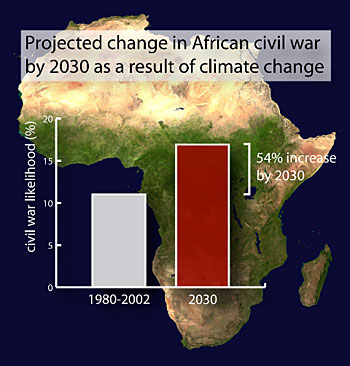
Late last year the Proceedings of the National Academy of Science published a paper by Burke et al which claimed that climate change resulting from greenhouse gas emissions was dramatically increasing civil wars in Africa, and this trend would continue in the near term.

The Cal-Berkeley press release included this quote (and the image above) from one of the authors:
"We were definitely surprised that the linkages between temperature and recent conflict were so strong," said Edward Miguel, professor of economics at UC Berkeley and faculty director of UC Berkeley's Center for Evaluation for Global Action. "But the result makes sense. The large majority of the poor in most African countries depend on agriculture for their livelihoods, and their crops are quite sensitive to small changes in temperature. So when temperatures rise, the livelihoods of many in Africa suffer greatly, and the disadvantaged become more likely to take up arms."
Not long after, the paper was strongly criticized in a reply also published in PNAS:
[T]he proposition by Burke et al. (1) that warming may be a directly causative factor in the risk of civil war in Sub-Saharan Africa seems unlikely. . . Our greatest concern with the analysis is the characterization of the link between warming and large-scale conflict (>1,000 battle deaths). The title of the paper, “Warming Increases the Risk of Civil War in Africa,” suggests causation, but the evidence presented is not substantive enough to warrant such a conclusion. Although warming may serve as a proxy for correlated variables such as decreased soil moisture and reduced agricultural production, identifying warming, or even agricultural production, as primary factors in civil war oversimplifies systems affected by many geopolitical and social factors.
In their rejoinder to the reply Burke et al. appeared to back off their claims of causation:
Our paper does not argue that temperature is the only—or even the primary—determinant of civil war. Further work is needed to understand how climate affects civil war, and we note this clearly in our paper.
Just this week PNAS has published a new paper by Halvard Buhaug that thoroughly eviscerates Burke et al. Buhaug's conclusion is unambiguous (I do not see it at PNAS yet [UPDATE: Online here in PDF, Thx MC], but an early version is here in PDF):
The simple fact is this: climate characteristics and variability are unrelated to short-term variations in civil war risk in Sub-Saharan Africa. The primary causes of civil war are political, not environmental, and although environmental conditions may change with future warming, general correlates of conflicts and wars are likely to prevail. . . The challenges imposed by future global warming are too daunting to let the debate on social effects and required countermeasures be sidetracked by atypical, nonrobust scientific findings and actors with vested interests.
Burke has reacted strongly against Buhaug, accusing him of having cherry-picked his datasets (Note: Figure 2 in Buhaug is pretty convincing to me.).  While climate change may not be the cause of African civil wars, it does seem to be the cause of civil wars in academia.

19 comments:

Craig 1st said...

Shouldn't that be "uncivil" wars in academia?

Craig 1st said...

By the way, it seems to me that linking civil war to climate change is like saying there is a policy that is able to change climate.

The Iconic Midwesterner said...

I find it hysterical that someone who claimed to find climate change causation based upon only 20 years worth of data could have the temerity to cry "cherry picking!"

Mark B. said...

PNAS has long been a joke in the scientific community. It's where National Academy members send their low-quality work that they don't want subject to rigorous review.

Harrywr2 said...

From Buhaug's paper

"A preliminary inspection of the data appears to give some support to claims that
temperature drives African civil wars in that they tend to be concentrated in warmer
countries, including DR Congo, Ethiopia, Sudan, and Somalia."

A map of Soviet Strategic supply lines drawn in 1942. http://history.sandiego.edu/cdr2/WW2Pics/78903bg.jpg

A preliminary inspection of post WWII conflict would shows a high correlation with Soviet Strategic Supply lines.

Of course there is also correlation with the fact the places are warm, since Soviet Sea Ports tended to be frozen in the Winter.

Can I get some grant money now? :)

Jeff said...

This whole mess perfectly sums up the global warming debate. If you've paid any attention to Africa you know the problem is political chaos so, you know that if you want to help, your lowest priority action item right now is "climate change."
But wait, it gets worse:
If you've paid any attention to climate change, you know building windmills is the least effective solution to climate change.
And it gets even worse:
You know that pushing windmills through policies like the easily corruptible global ETS (and the like) schemes profit warlords- meaning you are fueling the civil wars.
And still it gets worse:
Forcing windmills via ETS combined with a carbon tax that kills economic development creates the chaos necessary for the newly ETS enriched warlords to launch the civil wars.
So, the argument is that we should adopt policies that are most likely to fuel the highest priority causes of civil wars (chaos/political) while allegedly addressing the lowest priority problem (climate change) via the least effective means (windmills).
And they wonder why the climate change policy proposals fail.
Amazing.

John M said...

Well, at least PNAS is publishing the Buhaug paper. The Burke paper just adds to a long string of POV "pieces" masquerading as research in what once was a top notch scientific publication.

Maybe PNAS should just start selling issues at news stands, where it can be properly placed next to Vanity Fair, Rolling Stone, and Harper's Magazine.

Timberati said...

@Jeff, you just summed up the whole AGW debate. Nicely done.

Stephen Pruett said...

Finally. A justifiably cautious study. There is a concept in statistics called face validity, which refers to reviewing the research problem at face value and applying expert knowledge of the system. Even if data are found which technically pass one or more statistical evaluations, questionable face validity should at the very least lead to extreme caution in interpreting the results. In the previous PNAS paper on civil war and climate change, and in another recent PNAS paper on migration, the dependent variables are already known to be very complex and influenced by many factors. Thus, on the face of it, the idea that climate change is a major determinant should be met with considerable caution. This is particularly the case because the mechanisms proposed to be involved are indirect and related to agricultural production, which is itself dependent on many factors, with climate being one that usually is not a critical determinant unless there is drought or flood. As pointed out by the owner of this blog, it has not been conclusively established that climate change is associated with increased risk of weather events that lead to increased economic losses. Hopefully, this paper and the fact that the NY Times, the BBC, and Nature reported on it means that an appropriate level of skepticism is being restored to this field.

David said...

Jared Diamond's "How Nations Choose to Fail or Succeed" convincingly shows how the Rwandan civil war, with its near 1m deaths, was created principally by a rising population density which eventually reached 760/sq mile, very high for an agricultural society.

Since all animals are more abundant in warm conditions, greater warming leads to higher population densities and hence more civil wars.

Thus warming, which is good for humans, is also bad for humans, at which point I will break off to put in my new funding proposal to continue this obviously crucial line of research.

Sylvain said...

It is not a new phenomenon to link AGW to conflict in Africa. Of course, the claim is easy to make but harder to defend.

A few years back Ban Ki-moon linked the conflict in Darfur to AGW. This was contested in Nature:

http://www.nature.com/nature/journal/v447/n7148/full/4471038b.html

Interestingly some people used the same defense that it was only part of the reason for the conflict and not the sole reason of the conflict.

Back then there was an interesting article on rainfall that was published here:

http://iopscience.iop.org/1748-9326/3/3/034006/fulltext

Tucci said...

--
I could not deny that climate changes tend to figure as causative factors in armed conflict, but chiefly in pre-industrial societies where the survival margin is narrow or nil, and most of the populations are obliged to survive by way of sustenance farming or fishing or hunting.

It is far more likely that the warfare seen in sub-Saharan Africa over the past several decades has been the result of political pathologies, chiefly the endemic tribal rivalries which antedate the more recent bloodshed by decades and even centuries.

I recommend a recent (30 August) entirely unscholarly opinion piece - most probably written by the site's proprietor, Jim Dunnigan - at http://tinyurl.com/24u2hz5 for an insight providing historical context which tends to be utterly lacking in the various legacy media.

These are not civil wars as we understand them in the West. They are TRIBAL conflicts exacerbated by the malignancy of dirigiste civil government in the guise of socialism.

Such climate effects as may be are coincidental, not causative. Might as well argue that the dampness of a fever-wracked and sweating patient with pneumonia is the cause rather than an incidental physical sign of his pathology.
--

jgdes said...

And all on 0.6K per century and zero K over the last 12 years. Almost anything can be correlated but if he'd been unwise enough to hint that it was a cultural phenomenon he'd have been sacked for being politically incorrect. Conversely you can say anything is linked to climate change because that is hugely politically correct. Academia at it's most laughable!

madadadam said...

Find just one of these civil wars where the combatants aren't split on tribal/religious grounds.
Huttu v Tutsi in Rwanda & Burundi
Zaghawa & Tama in Chad
Eritreia - Muslim v Christian.
The list is endless.
Climate change will be a factor, along with rising populations caused by better healthcare but without birth control, both putting pressure on agriculture, either by loss of agricultural land due to desertification (overgrazing & rainfall changes) or encroaching population centres. Add in deforestation, over use of water resources and control of mineral wealth and we're in the mess seen today.

itisi69 said...

"(UK)Business secretary Vince Cable will say in a speech today that there's no justification for spending money on research that is 'neither commercially useful nor theoretically outstanding'"

Link: http://www.guardian.co.uk/science/2010/sep/08/vince-cable-scientists-spending-review

mcrok said...

Hi Roger,
the def version is here:
http://www.pnas.org/content/early/2010/08/30/1005739107

Roger Pielke, Jr. said...

-16-mcrok

Thanks! Updated with the link

Frontiers of Faith and Science said...

In the Catholic age, events were seen through the lens of the Church, and all questions could be answered by by what the Church said on a given topic.
In the age of CO2, all questions are answered, "CO2".
The idea that CO2 is the reason why Africa will continue to bleed is great if you simply ignore history and reality.
But in the age of CO2, it is the answer. Especially if you want a nice tidy little grant to pay for your study and don't feel like working or thinking too hard.
This study illustrates the old saying 'simple answers for simple minds' rather well, actually.

Vineet said...

I am really surprised how can reviewers allow this to get published. It is just bad science because of which nobody would ever believe climate scientists. There are many different examples that can be cited when higher temperature did not cause conflict. Did these armchair scientists ever visited Africa to really understand what caused these conflicts? [Very Bad Science; This is not good for science]

Post a Comment