19 May 2011

College Grads Can't Find Work, Employers Can't Find Skills

Here is a remarkable juxtaposition: Today, ManpowerGroup issued its sixth annual survey of global "Talent Shortage" finding a pronounced shortage of skilled workers around the world (PDF).  Also today, the New York Times has a front page story about the difficulties that college graduates have in the United States finding jobs.

There is obviously a policy problem here, and some of it has to do with what universities are (or are not) doing.

Here is an excerpt from the Manpower report:
As we enter the Human Age, when human spirit and potential will become the driving force behind enterprise and innovation, having the right people in the right place at the right time becomes more critical than ever. Yet, as the global economic recovery continues, employers report increased difficulty filling open positions, despite an apparent surplus of talent amid high unemployment.

This year, Manpower expanded its sixth annual Talent Shortage Survey not only to gauge where employers are having difficulty filling available positions, but also examine why organizations are facing a lack of talent and what they are doing to mitigate these challenges. The results reveal increased difficulty finding the right talent in the wake of global economic recovery with limited effort to systematically fill the gaps—and notable regional variances.

• ManpowerGroup research reveals employers in India, the United States, China and Germany report the most dramatic talent shortage surges compared to last year. In India, the percentage of employers indicating difficulty filling positions jumped 51 percentage points.

• Nearly one in four employers say environmental/market factors play a major role in the talent shortage—employers simply aren’t finding anyone available in their markets. Another 22% of employers say their applicants lack the technical competencies or “hard” skills needed for the job, while candidates’ lack of business knowledge or formal qualifications is the main reason identified by 15% of employers.

• Approximately three-quarters of employers globally cite a lack of experience, skills or knowledge as the primary reason for the difficulty filling positions. However, only one in five employers is concentrating on training and development to fill the gap. A mere 6% of employers are working more closely with educational institutions to create curriculums that close knowledge gaps.
Here is a figure from the NYT article showing employment success rates of recent college graduates:

The Manpower report lists the top 10 job areas for which shortages have been reported in the US (it also has similar lists for countries around the world):
1 Skilled Trades Workers
2 Sales Representatives
3 Engineers
4 Drivers
5 Accounting & Finance Staff
6 IT Staff
7 Managers/Executives (Management/Corporate)
8 Teachers
9 Secretaries, PAs, Administrative Assistants & Office Support Staff
10 Machinists/Machine Operators
Interesting but not surprising to me (as a professor in an environmental studies program) is that such "area studies" graduates do the worst.  According to the NYT:
Young graduates who majored in education and teaching or engineering were most likely to find a job requiring a college degree, while area studies majors — those who majored in Latin American studies, for example — and humanities majors were least likely to do so. Among all recent education graduates, 71.1 percent were in jobs that required a college degree; of all area studies majors, the share was 44.7 percent.
The issues cannot be boiled down to a simplistic and misleading distinction between so-called "hard" disciplines versus "soft" disciplines (in my courses I distinguish between "hard" disciplines and "difficult" disciplines, with my courses falling into the latter;-). Manpower makes clear that even in non-technical fields, such as sales, there is greater demand for skills such as, "Excellent oral presentation and communication skills, consultative approach: ability to read people, diagnose problems, critical thinking / problem-solving, first-rate organizational skills" just to name a few (PDF).  And in technical fields such as engineering and skilled trades such skills are also increasingly needed.

The consequences of the skills shortage ripple through the labor market:
An analysis by The New York Times of Labor Department data about college graduates aged 25 to 34 found that the number of these workers employed in food service, restaurants and bars had risen 17 percent in 2009 from 2008, though the sample size was small. There were similar or bigger employment increases at gas stations and fuel dealers, food and alcohol stores, and taxi and limousine services.

This may be a waste of a college degree, but it also displaces the less-educated workers who would normally take these jobs.

“The less schooling you had, the more likely you were to get thrown out of the labor market altogether,” said Mr. Sum, noting that unemployment rates for high school graduates and dropouts are always much higher than those for college graduates. “There is complete displacement all the way down.”
This is not an easy problem to address, but I am convinced that universities must be part of the solution. Expect more on this topic from this blog in the future.

The Politics of Fungibility

The Obama Administration is soon to decide on whether or not to approve the building of a new pipeline from Canada's oil sands to US refineries. Even though the proposed pipeline cuts through a bunch of Red (Republican) states, my prediction is that the Obama Administration will approve the pipeline, regardless of the opposition. The simple reason for this expectation is that the recovered petroleum will either go to the US or, if not the US, to China. The last thing that the President will want during an election campaign is to eschew close and secure Canadian oil while gasoline prices are a national concern.

According to the FT today:
The Canadian province of Alberta could be one of the seven largest oil producers in the world by the end of the decade, its energy minister has said, as he urged the US to back a pipeline project that is vital for the industry’s expansion plans.

Ron Liepert, Alberta’s minister of energy, said that the US “has to make a decision” about whether it wanted the province’s oil, and that he was “proceeding all-out to find alternative markets for our product”, particularly in China. . .

Mr Liepert said Chinese companies, which are already active in the oil sands, “will take every drop we are able to produce, in a heartbeat.”
The fungibility of global oil supply means that reducing use of a particular source of oil in one place simply means that it will be consumed in another, and oil from elsewhere will have to fill that gap. Here is a nice explanation:
While Kenneth Medlock III, energy expert at Rice University, understands the environmentalists’ hope of reducing carbon emissions, he insists that if the US does not import the oil sands, someone else will, noting there is a project underway to export it to the Pacific Basin. Canada would then provide more fuel to China, which would require less fuel from the Middle East. That Middle East fuel would go to Europe and the US would get more of its fuel from Africa:
The protests are not going to stop oil sands development. You have to think of the world as one big bathtub. It doesn’t matter which end of the tub you fill from, as long as you are adding supply. The oil is going to flow.
He is right. The oil is going to be produced, and somebody is going to buy it. If the environmentalists truly want to make a difference, perhaps their focus should switch to pressuring the oil industry to work harder to reduce the carbon footprint of oil sands’ development. Surely nobody can object to that?
Efforts to develop alternatives to oil consumption via technological innovation would be even better yet.

The Science and Politics of Wedges

To follow up on my post yesterday on the so-called "stabilization wedges" of Rob Socolow and Steve Pacala, I thought that it would be useful to revisit the substantive reasons why it is that the wedges analysis has beem so misleading in the climate debate. I thought it also would be useful to add a perspective on why it is that some parts of the environmental community go on the attack when it comes to those who have criticized the wedges.

NYU physicist Marty Hoffert provides a concise explanation as to the problems with the approach, when it is used to imply that we need 7 (or now 8) wedges to "solve" climate change for the next 50 years (emphasis added):
Pacala and Socolow (8) analyzed a scenario that envisioned stabilizing atmospheric concentrations of CO2 at 500 ppm within 50 years. They found that reaching that goal required the deployment of seven existing or nearly existing groups of technologies, such as more fuel-efficient vehicles, to remove seven “wedges” of predicted future emissions (the wedge image coming from the shape created by graphing each increment of avoided future emissions). Those seven wedges, each of which represents 25 gigatons of avoided carbon emissions by 2054, are cited by some as sufficient to “solve” climate change for 50 years (9).

Unfortunately, the original wedges approach greatly underestimates needed reductions. In part, that is because Pacala and Socolow built their scenario on a business as usual (BAU) emissions baseline based on assumptions that do not appear to be coming true. For instance, the scenario assumes that a shift in the mix of fossil fuels will reduce the amount of carbon released per unit of energy. This carbon-to-energy ratio did decline during prior shifts from coal to oil, and then from oil to natural gas. Now, however, the ratio is increasing as natural gas and oil approach peak production, coal production rises, and new coal-fi red power plants are built in China, India, and the United States (10).

The enormous challenge of making the transition to carbon-neutral power sources becomes even clearer when emissions-reduction scenarios are based on arguably more realistic baselines, such as the Intergovernmental Panel on Climate Change’s “frozen technology” scenario ( 11, 12). Capturing all alternate energy technologies, including those assumed within this BAU scenario, means that a total of ~18 of Pacala and Socolow’s wedges would be needed to curb emissions (13) (see the figure). And to keep future warming below 2°C . . . an additional 7 wedges of emissions reductions would be needed— for a total of 25 wedges (see the figure).
The total is even more than 25 wedges if you want to avoid using the oceans as a store of carbon dioxide or reduce emissions below 2010 levels.. The numbers that Hoffert presents in his perspective are the same as those that I present in The Climate Fix, under a similar analysis.

What does a "wedge" mean in more intuitive terms?  Jom Romm helps to explain:
. . . [one wedge] by 2050 would require adding globally, an average of 17 [nuclear] plants each year, while building an average of 9 plants a year to replace those that will be retired, for a total of one nuclear plant every two weeks for four decades — plus 10 Yucca Mountains to store the waste.
Romm thinks we need about 14 "wedges" of effort to stabilize carbon dioxide concentrations at 450 ppm, and if one wedge implies a need for 26 nuclear plants per year, then 14 wedges implies 26 * 14 = 364 plants per year, or the equivalent effort of one nuclear power plant per day of carbon-free energy.  If you accept Hoffert's arguments, then using Romm's conversion you'd need 26 * 25 = 650 nuclear plants worth of carbon free energy, or closer to 2 per day.

This task -- at either Hoffert's or Romm's level of effort -- is clearly impossible with today's technology.

One might think that the modern environmental movement is adept enough at simple math to accept this message and thus proceed to advocate policies consistent with our lack of technological capabilities, such as calling for a much greater commitment to innovation. While some have, of course, the loudest, most well funded and arguably most influential parts of the movement have strenuously resisted the notion that we do not have the technology needed to rapidly decarbonize our economy, preferring to hold on to the myth that -- in the words of the original "wedges" paper -- "Humanity can solve the carbon and climate problem in the first half of this century simply by scaling up what we already know how to do."  I discuss this myth at length in Chapter 2 of The Climate Fix.

What explains the environmental community's strict adherence to bad math and flawed policy?

In an overlooked part of Matt Nisbet's recent report titled Climate Shift (see his Chapter 2), Nisbet explained that the American environmental community decided to unite under a common set of strategies that were expressed in a  2007 report called Design to Win (PDF, I earlier critiqued the report as "Doomed to Fail").   This common approach would allow efforts to be coordinated and reinforcing. Central to the approach was the so-called wedges and the misleading notion that we have all the technology that we need, meaning that the challenge was one of shaping political will and public opinion. On the scientific advisory committee of the DTW report was Robert Socolow.

The 2007 Design to Win report explains that to 2030, 80% of emissions reductions could be achieved with existing technologies and at little or no cost (the figure is from the report):
The good news is that we already have the technology and know-how to achieve these carbon reductions – often at a cost-savings. Design to Win’s synthesis of the latest scientific and economic analyses, including the Stern Review, Vattenfall climate abatement map prepared by McKinsey & Company, and reports by the Intergovernmental Panel on Climate Change, concluded that about 80 percent of the needed mitigation – 25 gigatons of carbon – can be achieved with existing technologies (Figure 4). The key lies in rapidly deploying such technologies in our power plants, buildings, factories and vehicles, and improving land management practices.
The focus on deployment, often to derision if not the exclusion of the need for innovation, is still central to environmental messaging, even as the math of emissions reductions would seem obvious and the policy centerpiece of DTW -- cap-and-trade -- has failed comprehensively.

What explains the adherence to bad ideas in the form of bad policy?  I'm not entirely sure but it just so happens that groups such as the Center for American Process have been funded under the Design to Win strategy to spread its message. Apparently that includes a healthy dose of efforts to delegitmize alternative points of view and to poison what otherwise might be characterized as a healthy public debate over policy options.  To the extent that these efforts succeed, climate policy and the broader environmental movement suffer.

18 May 2011

Relative Carbon Dioixde Emissions in the US and Europe

A colleague asked me if I could gin up a graph showing relative carbon dioxide emissions for the US and Europe since 1990, with 1990 set to 1.0.  Here is that quickly-made graph; the data comes from the US EIA.  In case you are curious, the European countries with relatively lower emissions in 2009 than the US (off of the 1990 baseline) are Germany, the UK, Denmark and Sweden.  The picture looks different with a 2000 baseline.

When the Hurricane Drought Ends

The United States is currently in the midst of a remarkable streak. The figure above shows the number of days in between intense hurricane landfalls (S/S Category 3-4-5).  As of June 1st, the start of the 2011 hurricane season that streak will have reached 2,046 days the third longest on record, surpassed only by the 2,136 days between landfalls of October 11,1909 and August 17,1915 and the 2,231 days between September 8,1900 and October 18, 1906. The data comes from the ICAT Damage Estimator.  I'd be surprised if the US went through another hurricane season without an intense hurricane landfall, simply based on the well-tested methodology that says good luck can't last forever.

17 May 2011

Socolow: Wedges Were a Mistake

[UPDATE: Socolow responds to Joe Romm, and undercuts many of Romm's arguments (e.g., that a wedge should be thought of over a "few decades", no says Socolow, they were 50 years; that we can reduce emissions by efficiency alone, no says Socolow; that the wedges suggest 450 ppm -- much less 350 ppm -- is a realistic target, Socolow says no. Apparently, Socolow does not read Romm's blog (I've updated the below to acknowledge this).  Romm says he is unfamiliar with my views on climate policy, so I'll send him a link to my book with an invitation to offer a substantive critique.]

National Geographic has a pretty remarkable story up on the so-called "stabilization wedges" approach to reducing emissions (thx DM). The article has a number of lengthy quotes from Robert Socolow (co-author with Stephen Pacala on the paper) in which he says that their paper was misunderstood and misused by the advocacy community.  Socolow's comments reinforce a number of arguments that I make about the wedges in Chapter 2 of The Climate Fix.

Here are a few choice excerpts from the National Geographic article:
When the torrent of predictions about global warming got too depressing, there were Robert Socolow's "wedges."

The Princeton physics and engineering professor, along with his colleague, ecologist Stephen Pacala, countered the gloom and doom of climate change with a theory that offered hope.  If we adopted a series of environmental steps, each taking a chunk out of the anticipated growth in greenhouse gases, we could flatline our emissions, he said. That would at least limit the global temperature rise, he said in a 2004 paper in the journal Science.

The Princeton colleagues even created a game out of it: choose your own strategies, saving a billion tons of emissions each, to compile at least seven "wedges," pie-shaped slices that could be stacked up in a graph to erase the predicted doubling of CO2 by 2050.

It was a mistake, he now says.

"With some help from wedges, the world decided that dealing with global warming wasn't impossible, so it must be easy," Socolow says.  "There was a whole lot of simplification, that this is no big deal."

He said his theory was intended to show the progress that could be made if people took steps such as halving our automobile travel, burying carbon emissions, or installing a million windmills. But instead of providing motivation, the wedges theory let people relax in the face of enormous challenges, he now says.
Socolow takes issue with how his work has been misused by advocates for action:
Socolow said he believes that well-intentioned groups misused the wedges theory. His theory called for efficiency, conservation, and energy alternatives that could keep greenhouse gas emissions at roughly today's levels, offsetting the growth of population and energy demands. Global temperatures would rise by 3°C.

"I said hundreds of times the world should be very pleased with itself if the amount of emissions was the same in 50 years as it is today," he said.

But those inspired by the theory took it farther.  If Socolow's wedges could stabilize emissions with a 3-degree rise, they said, even bigger wedges could actually bring greenhouse gases back down to a level resulting in only a 2-degree rise. (This is the goal that 140 nations have pledged to try to achieve in the Copenhagen Accord.)

"Our paper was outflanked by the left," Socolow said.  But he admits he did not protest enough: "I never aligned myself with the 2-degree statement, but I never said it was too much."

In holding out the prospect of success, adherents stressed the minimal goals, and overestimated what realistically could be achieved.

"The intensity of belief that renewables and conservation would do the job approached religious," Socolow said.
Of course, no one has abused the "wedges" analysis more than Joe Romm who did exactly what Socolow is critical of -- Romm super-sized each one of the wedges, doubled the number needed, and then claimed based on his perversion of the Socolow/Pacala analysis that we have (or soon will have) all the technology needed to stabilize concentrations of carbon dioxide at 450 (or even 350) ppm. It is hard to imagine that Socolow's comments can be in reference to anyone other than Romm, who has probably done more to confuse issues of mitigation policy than anyone [UPDATE: Socolow says he is unfamiliar with Romm's views.].  Back in 2008 I pointed out Romm's egregious misuse of the wedges analysis to imply that achieving deep emissions cuts would be technologically and economically possible with technologies currently (or soon to be) available. The exchange with Romm was precipitated by a paper with Chris Green and Tom Wigley in which we explained how the IPCC had made a similar error in its analysis (here in PDF).

Socolow's strong rebuke of the misuse of his work is a welcome contribution and, perhaps optimistically, marks a positive step forward in the climate debate.

Lack of Quality in University Education

Over the weekend Richard Arum and Josipa Roksa has a provocative, and I think spot on, op-ed in the New York Times on the poor quality of university education in the United States. They write:
Over four years, we followed the progress of several thousand students in more than two dozen diverse four-year colleges and universities. We found that large numbers of the students were making their way through college with minimal exposure to rigorous coursework, only a modest investment of effort and little or no meaningful improvement in skills like writing and reasoning.

In a typical semester, for instance, 32 percent of the students did not take a single course with more than 40 pages of reading per week, and 50 percent did not take any course requiring more than 20 pages of writing over the semester. The average student spent only about 12 to 13 hours per week studying — about half the time a full-time college student in 1960 spent studying, according to the labor economists Philip S. Babcock and Mindy S. Marks.

Not surprisingly, a large number of the students showed no significant progress on tests of critical thinking, complex reasoning and writing that were administered when they began college and then again at the ends of their sophomore and senior years. If the test that we used, the Collegiate Learning Assessment, were scaled on a traditional 0-to-100 point range, 45 percent of the students would not have demonstrated gains of even one point over the first two years of college, and 36 percent would not have shown such gains over four years of college.
The op-ed summarizes arguments found in their recent book, Academically Adrift: Limited Learning on College Campuses. Inside HigherEd provides some more details:
The main culprit for lack of academic progress of students, according to the authors, is a lack of rigor. They review data from student surveys to show, for example, that 32 percent of students each semester do not take any courses with more than 40 pages of reading assigned a week, and that half don't take a single course in which they must write more than 20 pages over the course of a semester. Further, the authors note that students spend, on average, only about 12-14 hours a week studying, and that much of this time is studying in groups.

The research then goes on to find a direct relationship between rigor and gains in learning:

Students who study by themselves for more hours each week gain more knowledge -- while those who spend more time studying in peer groups see diminishing gains.

Students whose classes reflect high expectations (more than 40 pages of reading a week and more than 20 pages of writing a semester) gained more than other students.

Students who spend more time in fraternities and sororities show smaller gains than other students.

Students who engage in off-campus or extracurricular activities (including clubs and volunteer opportunities) have no notable gains or losses in learning.

Students majoring in liberal arts fields see "significantly higher gains in critical thinking, complex reasoning, and writing skills over time than students in other fields of study." Students majoring in business, education, social work and communications showed the smallest gains. (The authors note that this could be more a reflection of more-demanding reading and writing assignments, on average, in the liberal arts courses than of the substance of the material.)

In section after section of the book and the research report, the authors focus on pushing students to work harder and worrying less about students' non-academic experiences. "[E]ducational practices associated with academic rigor improved student performance, while collegiate experiences associated with social engagement did not . . .
Meantime, and perhaps paradoxically, the US is facing a shortage of highly skilled workers:
Even with unemployment near 9%, manufacturers are struggling to find enough skilled workers because of a confluence of three trends.

First, after falling for more than a decade, the number of U.S. manufacturing jobs is growing modestly, with manufacturers adding 25,000 workers in April, the seventh straight month of gains, according to payroll firm Automatic Data Processing Inc. and consultancy Macroeconomic Advisers. The Labor Department's jobs report on Friday is expected to show moderate employment growth in the overall economy.

Second, baby-boomer retirements are starting to sap factories of their most experienced workers. An estimated 2.7 million U.S. manufacturing employees, or nearly a quarter of the total, are 55 or older.

Third, the U.S. education system isn't turning out enough people with the math and science skills needed to operate and repair sophisticated computer-controlled factory equipment, jobs that often pay $50,000 to $80,000 a year, plus benefits. Manufacturers say parents and guidance counselors discourage bright kids from even considering careers in manufacturing.
There is a lesson here, are universities listening?

NYT on UK Climate Policies: Rah! Rah!

Apparently the New York Times could not find a single person to raise questions about the UK's recent commitment to increasing its long-term emissions reduction targets, preferring instead to cheerlead:
Britain is poised to announce some of the world’s most ambitious goals for reducing greenhouse gas emissions — a striking example of a government committing to big environmental initiatives while also pursuing austerity measures. . .

“This is an outstanding example of the kind of action by developed-world countries that’s needed to bring climate change under control,” said Bert Metz, an adviser to the European Climate Foundation, a group in Brussels that advocates lower emissions, and a former member of the Intergovernmental Panel on Climate Change. “It’s also really going to push the British economy in the direction of growth.”
Not shared with readers is the fact that the UK has badly missed its 2010 emissions reduction target, is expected to continue to miss its short-term targets and has set targets but not policies to achieve them.

Ah, details.

16 May 2011

Rajendra Pachauri 2.0

From Australia come some interesting quotes from Rajendra Pachauri, chairman of the IPCC, perhaps showing a new approach.

First, on recent extreme events:
"Frankly, it is difficult to take a season or two and come up with any conclusions on those on a scientific basis," Dr Pachauri said.

"What we can say very clearly is the aggregate impact of climate change on all these events, which are taking place at much higher frequency and intensity all over the world.

"On that there is very little doubt; the scientific evidence is very, very strong. But what happens in Queensland or what happens in Russia or for that matter the floods in the Mississippi River right now, whether there is a link between those and climate change is very difficult to establish. So I don't think anyone can make a categorical statement on that."
When given a chance to opine on Austalia's climate politics, he took  pass:
[W]hen it came to commenting on the state of Australian politics and climate change, Dr Pachauri played a straight bat literally.

Anticipating questions about whether Australia was doing enough, he said he had rehearsed his lines.

"Australia is not doing enough in cricket. About climate change, I just can't say."

He said the IPCC was "doing what we can" in relation to concerns about its reputation.

"We . . . are focused on producing the best possible reports that we can. It is really up to governments to take actions that are in their best interests and society at large."

On Attribution, A Response to Parmesan et al.

In the current issue of Nature Climate Change I have a correspondence in response to the commentary by Camille Parmesan and colleagues on attribution of specific biodiversity outcomes to human caused climate change. They argued:
The biological world is responding rapidly to a changing climate, but attempts to attribute individual impacts to rising greenhouse gases are ill-advised.
Keith Kloor had a nice discussion of that piece when it came out.

In my response, I focus on the underlying political incentives for such claims of attribution:
Parmesan and co-authors1 offer a welcome tonic to overstated claims that attribute various localized changes in biological systems to human-induced climate change. However, their Commentary is off target when it lays blame for the misguided focus on attribution on the Intergovernmental Panel on Climate Change (IPCC) “effectively yield[ing] to the contrarians’ inexhaustible demands for more ‘proof.’” As compelling as battle with the sceptics seems to be in virtually every aspect of the climate issue, the overstated role of attribution in the climate debate has a far more prosaic origin in the fundamental design of the Framework Convention on Climate Change.
Read the rest of my response here in PDF.

If you are interested in learning more about how the political context of climate policy creates incentives for claims of attribution, and how this hurts climate policy, please see Chapter 6 in The Climate Fix as well as these two papers:

Pielke, Jr., R. A. (2004), What is climate change?. Issues in Science and Technology 20 (4) 31-34.

Pielke, Jr., R. A. (2005), Misdefining ‘‘climate change’’: consequences for science and action. Environmental Science & Policy 8 (6) 548-561.

Return to Fantasy Island: Targets Wthout Policies

As I suggested last week, UK Prime Minister David Cameron has settled debate over UK emissions reduction targets in favor of adopting stronger targets far in the future. It seems that he is also interested in continued economic growth.

Meantime, back in the present Cambridge Econometrics reports that the UK has missed it 2010 emissions reduction target, despite the dramatic effects of the economic downturn. The report sees the UK continuing to miss its near-term targets, with the difference between target and performance increasing over time. Environmental groups continue to confuse the effects of a shrinking economic downturn with progress on reducing emissions.  Looking ahead, the UK economy is currently positioned to have economic growth or a continued reduction in emissions, but not both.  Emissions in 2010 increased sharply.

Cambridge Economietrics explains the basic dynamics at work here:
[T]here is now a firm policy commitment (made by the previous government and now endorsed by the Coalition government) but as yet no firm policies in place ...
Targets without policies.  Doesn't sound too promising, does it?

12 May 2011

Japan's New Emissions Math

Yesterday I posted up a short bit from the IEA which asserted that a turn away from nuclear power will make reducing emissions more difficult.  Here are some numbers explaining how this works in the case of Japan.

Earlier this week the Japanese Prime Minister Naoto Kan announced that Japan was no longer seeking to source 50% of its energy needs from nuclear power and terminated plans for 14 new nuclear facilities.  What might this decision mean for Japan's ability to meet its current carbon dioxide emissions reduction target of 25% below 1990 levels?  Here I use wind as a measuring stick, but solar or other technologies could easily be used to tell the same story.

Here is what the Japanese government said would be needed to reach its earlier 5% reduction target:
  • Construct nine new nuclear power plant plants, improve utilized capacity to 80% (from 60%).
  • Install 5 million kW of wind power plants (equivalent to approximately 34 units).
  • Install solar panels on 5.3 million homes (an increase of 2000% over current levels).
  • Increase the share of houses satisfying stringent insulation standards out of total newly built houses from 40% today to 80%.
  • Increase the share of next generation vehicle out of total sales of new vehicles from 4% (2005) to 50% (2020).
Replacing 9 nuclear plants (1 GW at 0.8 capacity) with wind would imply in round numbers about 10,000 2.5 MW wind turbines (at 0.3 capacity) (See The Climate Fix for details).  Currently, Japan has about 1,700 wind turbines.  These 10,000 new ones are on top of the 6,600 already in the assumptions, or an increase of about 10 times current levels of deployment.

And this is just for the 5% reduction target.  You'd have to multiply by more than 5 to get to the 25% reduction target.

Japan currently gets 24% of it energy needs from nuclear power.  To replace that additional 26% that was supposed to come from nuclear (to get to 50%) implies 78,000 (!) 2.5 MW wind turbines (see TCF, p. 144, Table 4.4). The Japanese Wind Energy Association optimistically foresees 11.1 GW of capacity by 2020, or less than half that would have been needed to reach the 5% reduction target.  Abandoning nuclear does not make the emissions reduction targets easier, but far, far more difficult. 

I have argued that Japan's 2020 emissions reduction target of a 25% reduction was always far out of reach.  I don't think that the phrase "even more impossible" makes much sense, but perhaps Japan's new political context will at least make its emissions reductions commitments "even more obviously impossible."  Then again, there is always the appeal of magical solutions.

11 May 2011

Preview of IEA Low Nuke Scenario

The FT shares a preview of the IEA's "low nuclear" scenario forthcoming in November:
The IEA will publish its annual global energy outlook in November, which will include a “lower nuclear case” mapping what would happen if the world added only 180 gigawatts of new nuclear capacity by 2035, rather than the 360 predicted in the last outlook.

It found three consequences:
  1. The world will make up for the shortfall with gas, renewables and coal (coal and gas in China, gas and renewables in Europe and the US). That would put pressure on gas and coal prices, which would in turn make electricity generation more expensive.
  2. There will be less diversification of the energy mix, which is bad news for energy security.
  3. There might be about half a gigatonne more CO2 in the atmosphere, making climate targets much more difficult to achieve.
Keith Kloor and Shellenberger/Nordhaus each have thoughtful discussions of the current politics of nuclear power and consistent with the IEA preview.  There are no easy answers. 

David Keith on the APS Report

David Keith of the University of Calgary (pictured above) has posted up a detailed response to the APS air capture report (here in PDF).  Here is how it starts out:
The APS report does a fine job explaining the physics and chemistry of air capture (AC). We are pleased that the APS assembled such an excellent and diverse group of researchers to assess this technology at such an early stage in its development.

Our view about the costs of air capture diverges substantially from that of the APS. We acknowledge our bias and self-interest as developers of AC technology, but we believe that many of the key claims made here are independently verifiable.

The APS cost estimate for direct air capture depends on: (1) the performance of the APS reference design, (2) the choice of the reference design itself, and, (3) the validity of the cost estimating methods applied to the reference design.

We concur that the methodsused for cost estimation conform to industry practice, and applaud the report for laying these out in a transparent manner. In these slides we offer comments on items 1 and 2. In summary:

1.There are substantial technical discrepancies between APS’s performance model and estimates produced by industry-standard reference sources.

2.The choice of the APS’s reference design results in very high costs without a clear justification in terms of the tradeoff between cost and technical risk.
Keith also shares these comments with me by email, posted with his permission:
We have a paper under review that makes these points are more systematic way of lots of analysis.

Showing that a silly design is expensive proves nothing. To show that air capture expensive you need to show that a SENSIBLE design is expensive. That is, a sensible design at full industrial scale within a decade using low risk hardware.

An analogy: Suppose you are to estimating the cost of passenger jet traffic across the Atlantic in 1955. You need choose an aircraft design analogy as a starting point from which to scale and adjust your estimate. If you start with an F104 as your base case, one person per aircraft, you will get an foolish estimate about the actual cost per passenger of the 707 which was cheap because it was big and simple.

Starting with packed towers with stainless packing when there are commodity systems now on the market that will do the job for NaOH air capture is like starting with the F104. The APS did a fine job (ignoring the mistakes) costing the F104, but the choice of reference drives the answer.

Why did they not try several different systems and evaluate the cost-risk tradeoff? It's a mystery to me.
One thing here is for certain -- competition is good for both innovation and understanding.  Let's hope that it continues.

UPDATE 5/12: The following comments were shared with me by email for posting from Dr Tim Fox, Head of Energy and Environment, Institution of Mechanical Engineers, London, UK
I have read this report from the APS in full and its findings are based primarily on a detailed assessment of a single direct air capture technology proposal that has an energy intensive process at its core. The study also draws conclusions that largely ignore current thinking on the possible uses of this approach in climate change mitigation.

Air capture machines and processes represent a promising technology for the deployment of additional methods in tackling the challenge of global warming. However, given the early-stage and often proprietary nature of research and development in this area there is considerable uncertainty as to future cost levels. It is therefore premature to draw decisive conclusions as to the likely cost per tonne of CO2 captured. There are a number of other studies that suggest costs will be substantially lower than quoted by the APS and, indeed, given research, development and demonstration on a scale comparable with ‘conventional’ carbon capture and storage technologies (CCS) the approach might in certain circumstances gain near parity with that abatement option. We should however be clear that nobody is today seriously suggesting that in the case of power plant and large industrial emissions sources direct air capture would be considered as an alternative approach to CCS.

Air capture has the useful characteristic of being able to take advantage of the fact that direct removal of CO2 from the atmosphere can take place at any geographical location regardless of the point at which the gas is emitted. This enables the approach to be potentially used to tackle difficult sources, including large numbers of non-stationary emitters such as vehicles, aircraft and ships, or widely dispersed small scale industrial processes that are not amenable to CCS on technical or economic grounds. The technology also offers a wide range of other mitigation strategies including the removal of historic emissions accumulated in the atmosphere.

In summary, given the small amount of publicly available research and assessment data on proposed direct air capture technologies it is premature to draw any meaningful conclusions on the likely costs associated with the approach. As with CCS, the most promising technologies in this area need pilot testing and demonstration in the public domain to enable detailed cost assessments to be made, which will facilitate informed evidence-based decision making.

UK Coalition Carbon Row

An interesting debate is taking place among the coalition partners leading the UK government over carbon targets.  The Guardian provides some details:
The business secretary, Vince Cable, has clashed with his Lib Dem cabinet colleague Chris Huhne by telling him he will not support carbon reduction targets recommended by the government's independent climate change advisory body.

David Cameron will decide next week whether to accept the proposals by the Committee on Climate Change for a fourth carbon budget, covering the years 2023 to 2027, championed by Huhne, the energy secretary.

Three carbon budgets were set in 2008 but now the UK must agree a fourth as the government attempts to cut greenhouse gas emissions by 80% by 2050, compared with 1990 levels.

In a letter leaked to the Guardian, Cable tells his party's leader, Nick Clegg, and the chancellor, George Osborne, that he is "unable to give clearance to the proposal as it stands" and calls for an urgent cabinet meeting. In his letter, dated 19 April, Cable says the proposed carbon budget is not "cost effective" and asks for a Treasury impact analysis to be made available to all involved in the decision.

He writes: "Agreeing too aggressive a level risks burdening the UK economy, which would be detrimental to UK, undermining the UK's competitiveness and our attractiveness as a place to do business.
The April 19 letter being referred to can be found via the FT Westminster blog here in PDF.  The letter is in response to an April 5 letter from Chris Huhne, which discusses the commitment periods up to 2023.  It is all but certain that the UK won't hit those targets unless it adopts some very clever accounting and arithmetic.  Such cleverness is hinted at by the FT in its discussion of the April 5 Huhne letter (is it in the public domain?):
Interestingly, the letter also implies that Chris Huhne himself did not want to implement the entire CCC report. For example, the energy secretary seems to have rejected the idea that the second and third carbon budgets should be adjusted upwards. There is also a hint that he will not accept their idea of including aviation and shipping in the carbon targets.
Including aviation and shipping would of course make it far more difficult to pretend to be meeting the targets.

What will Cameron do?  I can't imagine he'd do anything other than commit to the targets proposed by the Climate Change Committee for 2030.  He'll be long gone by then.  They more important questions of course are about how the UK finagles the shorter term issues.

APS on Chemical Air Capture of Carbon Dioxide

Yesterday's New York Times has an article on a new report from the American Physical Society that discusses the chemical capture of carbon dioxide from the atmosphere. The bottom line from the APS report is that chemical air capture is perhaps four times as costly than the highest published estimates found in the peer-reviewed literature (APS report here in PDF, a recent survey of the literature here in PDF).

As is always the case in debates about technologies that do not yet exist, other experts have found reasons to disagree with the conclusions of the APS report, for instance:
Klaus S. Lackner, a physicist and director of the Lenfest Center for Sustainable Energy at Columbia University’s Earth Institute who created the company’s technology, criticized the American Physical Society study as too narrowly focused, saying it had analyzed only outdated technology.

Dr. Lackner said his design, which uses a plastic that absorbs carbon dioxide when dry and releases it to the air when wet, would eventually be capable of capturing the gas for far less than $600 a ton.

“I can assure you that if I believed it would cost $600 a ton, I would have given up long ago,” he said.

Mr. David of Kilimanjaro Energy also said the report had failed to take into account the use of captured carbon dioxide as a feedstock for biofuels, like those made from algae.

“What we’re into is making fuels,” he said. “If you can grab CO2 from the atmosphere and can do it economically, you can find yourself in the midst of the fuel business.”

Mr. Desmond, a co-chairman of the report, said his group had struggled to get sufficient data from private companies engaged in research into direct air capture. In the absence of data, claims that the process could be done cheaply were almost impossible to verify, he said.

“In the big scheme of things, those numbers don’t seem credible,” he said. “That’s my concern.”

Other analysts had mixed views. In an e-mail message, Sasha Mackler, director for energy innovation at the Bipartisan Policy Center, a Washington institute, agreed that direct air capture of carbon dioxide was probably decades away from making economic sense. But the market for alternative fuels could make the process far more profitable than forecast in the report, Mr. Mackler said.

“We are at far too early a stage to predict how this field will emerge in the years ahead,” he said.

“Now is not the time to be taking options off the table.”
I very much agree with this last sentiment, as I explain in detail in The Climate Fix which has a lengthy discussion of air capture (which has chemical, biological and geological technologies, APS deals just with a subset of the chemical approaches).

As far as dueling cost estimates for technologies that do not exist?  Call me a skeptic, but I'd prefer to evaluate technologies based on how they perform in the real world, not in expert reports or even peer reviewed papers.  As I have written elsewhere on air capture technologies, "There is little point in debating specific details about costs or large-scale feasibility until demonstration projects are undertaken" (PDF).

On air capture, chemical or otherwise, we should be skeptical until the technology is proven in practice. Until then, air capture should certainly be a part of a broad-based technology innovation portfolio.

American Ochlocracy

The Economist in its April 23rd edition (hey I'm behind;-) has an absolutely fantastic special report on California and democracy.  The special report is of much broader relevance to understanding issues of democracy more generally, and particularly the tensions between direct rule by the people and other forms of democratic governance.  The special report will be required reading in my fall graduate seminar.

10 May 2011

FIFA Governance and Legitimacy


Lord Treisman, former head of the English FA, airs some dirty laundry today before a committee of the UK Parliament, some juicy bits shown above. (A video of the whole session can be found here.) Meantime, Seth Blatter is "shocked" by allegations of corruption. FIFA is also facing allegations of systematic match fixing.

I doubt we've heard the last of this, as Triesman's testimony is not the sort of thing to be offered on a one-off basis. Expect more revelations to follow, and a battle for the future of FIFA that will certainly get even more interesting.

The Devil is in the Assumptions

After seeing several rather embarrassing articles yesterday in the media on the IPCC renewable energy report, it is good to see a few articles that get beyond the initial froth. Here are some excerpts from two very good articles.

The Financial Times, reliable as usual, focuses on the enormous costs implied by the IPCC:
As much as $15,000bn – more than the entire US government debt – will have to be found over the next two decades to develop the wind, solar and other renewable energy sources needed to keep global greenhouse gas emissions at bay, a UN report has concluded.

Close to 80 per cent of the world’s energy supply could be met by renewables by the middle of the century – up from 13 per cent in 2008 – according to the UN’s Intergovernmental Panel on Climate Change.

But that is likely to require sustained investment at a time when some of the world’s wealthiest countries may still be struggling with sovereign debt difficulties, a challenge acknowledged by the panel.

“The substantial increase of renewables is technically and politically very challenging,” said Professor Ottmar Edenhofer, co-chair of the IPCC working group that unveiled the report in Abu Dhabi on Monday.
As I suggested yesterday, it remains unclear what the IPCC thinks the costs are associated with its single 77% renewable scenario for 2050, as the costs were reported for only four reference scenarios.  Surely they must be higher than the highest reference scenario?

ClimateWire has a much harder-hitting piece, which focuses on the IPCC's reliance on "primitive biomass" in its future scenarios, implying that keeping poor people poor is going to be necessary to achieve high renewable penetration rates:
The world's leading climate change research organization issued a report yesterday that has renewable energy boosters cheering, as it foresees substantial growth in alternative energy sources over the next 40 years.

But the conclusions reached by that report's authors are colored with multiple caveats and uncertainties not captured by initial media coverage. And what the group chooses to identify as "renewable energy" incorporates one controversial practice while leaving others out.

Namely, the coalition of climate scientists includes traditional wood-burning in poor households' cookstoves as an example of renewable energy, though many experts say this is one of the leading causes of deforestation in the world.
ClimateWire explains:
[O]ne complicating factor potentially cancels out much of the optimism espoused yesterday.
The IPCC reaches its estimates by counting among renewable energy sources "traditional biomass" -- the widespread practice in the developing world of scavenging wood for producing charcoal or to burn directly for home heating and cooking.

The U.N.-sponsored body also includes solar photovoltaic, wind power, geothermal and ocean wave technologies as among the renewable sources. But the bulk of the estimated contribution of renewables to global energy supply in its future scenarios is achieved by estimating the energy derived from traditional biomass, according to the "Summary for Policymakers" and charts published by IPCC.
What does this mean?  Well, poor people stay poor:
IPCC researchers say their estimates show traditional biomass usage shrinking over time, to be gradually placed by more modern biomass generation, whereby trees felled are actually replanted. But charts showing the possible scenarios of the growth of renewables' share of energy still show biomass as the top source, even out to 2050.

The IPCC's blending of charcoal production with modern practices like biomass cogeneration on farms or wood waste burning near cities makes it difficult to determine how much traditional practices are to be replaced by more modern ones. But the IPCC admits that traditional biomass's share is larger, and the report suggests that its consumption will only fall slightly over the coming decades while modern biomass's share expands gradually.

"The number of people without access to modern energy services is expected to remain unchanged unless relevant domestic policies are implemented," IPCC officials explain.
The IPCC appears to be perfectly willing to make a wide range of assumptions about the implementation of relevant policies to the expansion of renewable energy.  Why not make assumptions about polices that seek to make poor people not poor? An interesting choice of what policies to assume are successful and which are not, no?

09 May 2011

IPCC on Renewable Energy

The IPCC has just issued a new summary for policy makers for a forthcoming special report on renewable energy that appears (indirectly and obliquely) to finally admit that we just do not have the technology necessary to achieve low targets for the stabilization of carbon dioxide in the atmosphere (e.g., something like 450 ppm).   You can download a copy here in PDF.  Here are some key passages.

First the report tallies the current proportion of global energy supply from renewable sources (p. 5, compare my January 2011 estimate which was very similar):
On a global basis, it is estimated that RE accounted for 12.9% of the total 492 Exajoules (EJ)5 of primary energy supply in 2008 (Box SPM.2) (Figure SPM.2). The largest RE contributor was biomass (10.2%), with the majority (roughly 60%) being traditional biomass used in cooking and heating applications in developing countries but with rapidly increasing use of modern biomass as well.6 Hydropower represented 2.3%, whereas other RE sources accounted for 0.4%.
The report discusses its 164 scenarios for the future (p. 18):
More than half of the scenarios show a contribution from RE in excess  of a 17% share of primary energy supply in 2030 rising to more than 27% in 2050. The scenarios with the highest RE shares reach approximately 43% in 2030 and 77% in 2050.
If renewable energy provides only 27% of energy supply in 2050 (the IPCC median scenario value), then this would imply that to meet a low stabilization target something like 60% or more of global energy supply would have to be produced by some other carbon-free energy source, such as coal or gas with CCS or nuclear power, neither of which seems to be possible without major technological innovation.

The IPCC does note that there are obstacles -- both social and technological -- that must be overcome, and appears to make some key assumptions about how this might occur (p. 12 -- exact details will have to await the full report, but track records for forecasting technological innovation and social acceptance are not so good):
A variety of technology-specific challenges (in addition to cost) may need to be addressed to enable RE to significantly upscale its contribution to reducing GHG emissions.
Even to reach the scenarios envisioned the report assumes a massive investment in energy technologies, from well over $100 billion per year to $500 billion per year starting yesterday (p. 23):
The four illustrative scenarios analyzed in detail in this Special  Report estimate global cumulative RE investments (in the power generation sector only) ranging from USD2005 1,360 to 5,100 billion for the decade 2011 to 2020, and from USD2005 1,490 to 7,180 billion for the decade 2021 to 2030.
The bottom line is that the IPCC has provided a rather sobering outlook for the deployment of renewable technologies.  Perhaps most surprising of all is that despite the sobering outlook, the word "innovation" appears only once and the notion of "research" into energy technologies appears only twice.  The IPCC continues to show blinders when it comes to energy technology innovation (see, e.g., PDF).

Poverty Distributions

Courtesy of The Economist.

07 May 2011

NOAA CSI on the Record Tornado Outbreak

NOAA's CSI group led by Marty Hoerling has put out an initial assessment (see also) of the recent tornado outbreak.  They conclude:
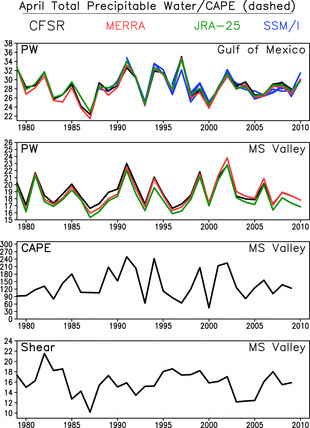
Our diagnosis attempts to reveal whether large-scale conditions may have become more favorable for violent storms to occur over the lower Mississippi Valley, the region of the recent super tornado outbreak. Various data sets are used to estimate the time variability in column precipitable water (Fig. 1, top 2 panels). These are found to be in close agreement with each other with respect to their interannual variability; the water vapor time series are dominated by strong year-to-year variations both over the Gulf of Mexico (top) source region and over the lower Mississippi Valley impact region of possible tornadic activity (second panel). A similar interpretation applies to a time series of thermodynamic stability (based on the index of convective available potential energy, CAPE) which as might be expected, varies coherently with the atmospheric water vapor content (third panel). Finally, the vector wind shear magnitude for the surface-500mb layer is also dominated by interannual variability, with little evidence for a trend during the 30-yr period (lower panel).

Neither the time series of thermodynamic nor dynamic variables suggests the presence of a discernable trend during April; any small trend that may exist would be statistically insignificant relative to the intensity of yearly fluctuations. A change in the mean climate properties that are believed to be particularly relevant to severe storms has thus not been detected for April, at least during the last 30 years. Barring a detection of change, a claim of attribution (to human impacts) is thus problematic, although it does not exclude that a future change in such environmental conditions may occur as anthropogenic greenhouse gas forcing increases.
The non-technical bottom line?

There is at present no indication that the environmental factors conducive to tornado development for this location and time have change over the last 30 years, meaning that no change has been detected.  Absent detection, there is no attribution.  As NOAA says, maybe there will be one day, but not yet.

06 May 2011

Have a Nice Weekend

Joe Romm Lies

[UPDATE 5/7: Joe Romm offers 3,300 wacky words in response to this short post. Crazy. Anyway, the simple response is, did Gore remove the slide I called him out on for using?  Answer: Yes.  Game, set, match.  For those many readers here for the first time (thanks Joe, this is now the second most viewed post in the history of this blog!) here is a link to my recent book on climate change.]

I do my best to ignore Joe Romm, but when he blatantly lies about me I sometimes feel compelled to respond. In today's installment Romm writes:
[The] false accusation that Gore was exaggerating came from none other than Roger Pielke, Jr.
He is referring to the time back in February, 2009 that I called Al Gore out for including a misleading slide in his famous climate change slide show.  Far from being a "false accusation" it was one that Al Gore actually agreed with and responded to immediately -- Much to Gore's credit, he agreed that the slide was misleading and immediately pulled it from his presentation.  Here is what his spokesperson said at the time (full statement at link above):
We appreciate that you have pointed out the issues with the CRED database and will make the switch back to the data we used previously to ensure that there is no confusion either with regards to the data or attribution.
Al Gore showed some real integrity in trying to get the science more right, something I praised him for at the time.

It is long overdue for the environmental community to start pushing back on Romm as he continues to stain their entire enterprise. His lies and smear tactics, which are broadly embraced and condoned, are making enemies out of friends and opponents out of fellow travelers.  Vigorous debate is welcome and healthy.  Lies and character assassination not so much.

The Green Blind Spot

Dave Roberts at Grist has post up critiquing Matt Nisbet's report in which he reveals a lot about the mindset of many American greens (of course, to the extent that Grist represents this community).  Roberts' critique clearly shows that greens have a huge blind spot when it comes to technology, it just doesn't factor in their calculus.

Roberts explains the world along two dimensions power politics on one end and ideas on the other:
Imagine, if you will, a spectrum: On one end, there are those who see politics as a battle of interests, a raw contest of "power politics" waged with the weapons of money and influence. "Post-truth politics," one might call it. On the other end, there are those who see politics as a battle of ideas, wherein the cleverest messaging and policy proposals attract the most reasonable people and public support, and win. Obviously there's a mix of the two, and one can come down anywhere in between on the spectrum.

In Nisbet's telling, the green movement has devoted itself to power politics when it's actually involved in a battle of ideas, and it's losing. It needs new ideas, new policies, new messages, not just more organizing and spending and lobbying. Cap-and-trade was always doomed because it's the wrong idea at the wrong time. That's why Nisbet tries to show that supporters of the climate bill were as powerful as opponents. If he can show that the sides were evenly matched in the battle of interests, then the only thing that can explain the loss is bad ideas.
Roberts thinks that Nisbet is focused to much on "ideas" and not enough on "power politics."  What is missed here is that policies lead to real world impacts, and all of the political power and good ideas in the world are impotent if they do not lead to practical action.  And absent an effective policy framework -- call it an "idea" if you want -- action will not occur.

Let's explore this with a thought experiment.  Imagine if there were in fact a cap-and-trade policy in place.  Imagine further that the government committed itself to getting off of fossil fuels and nuclear power, and had committed to high speed rail and even $7 $8.80 dollar-a-gallon gasoline.  Let's go further and imagine a near-universal commitment to green values among the public.  Surely, Roberts would find such a set of circumstances to be near nirvana.

We actually don't actually have to imagine such a set of conditions, they exist in a place called Germany.  And guess what?  German rates of decarbonization over the past decade have been exceeded by those in the United States.  How can that be if in Germany the political battle over climate has long been won?  Could it be that Germany climate policies are flawed in some sense?  That Germany needs some new ideas?

Decarbonizing the global economy is ultimately a technology problem.  It is simply not a problem of power politics or ideas, but rather, in implementing a set of policies that lead to technological innovation.  Roberts comes close to getting this, but doesn't make the connection, preferring to see technological change as a mere matter of political choice and not as a function technology itself:
Cheap fossil fuels have shaped America's infrastructure, industry, politics, land use, consumer habits, and self-image for over a century. They're woven into the fabric of U.S. history, commerce, and governance. Relationships among fossil-fuel execs, lobbyists, and politicians date back generations. Even if advocates for change can argue convincingly that there will be winners from the shift to a low-carbon economy -- more winners than losers, even -- the fact remains that many of the future losers currently wield enormous influence and the future winners don't yet exist, are not yet organized, do not yet have a history of cultural affiliation and financial common interest with politicians.
As the case of Germany shows, winning a political battle over green values does not compel policy outcomes related to specific technologies (in this case, I mean specifically accelerated decarbonizion to levels consistent with low stabilization levels).  The marriage of politics and policy in a way that accelerates decarbonization remains far away, in Germany and the United States.  So long as greens continue to ignore the central role of technology, and the role of policy in stimulating that innovation, they will find themselves in political battles with only the prospects of Pyrrhic victories.

05 May 2011

Social Media, Expertise and Truth

I am giving a talk today on social media (specifically expert blogging) and the practice of science.  In the FT today John Gapper has a highly relevant column to this subject, with his focus on the media, but which I think has a broader applicability.  Here are a few excerpts:
News has become faster and looser, as illustrated by the stream of facts, insight, rumours and propaganda that surged across news and social networks from the moment the White House announced that President Barack Obama would address the nation. It is becoming harder and more awkward for news providers to adhere to the old safeguards when they no longer dominate distribution.

In many ways, the rise of social media – the ability of anyone who has a computer or a smartphone to broadcast photographs, information and opinion – is a good thing. It allows experts to find an interested audience, and those who witness world-changing events – in this case the engineer who thought he had found a quiet place to live in Abbottabad until disturbed by helicopters – to report them.

But by loosening the grip that anchors and editors used to have, it places greater demands on the readers and viewers themselves. They must play a bigger role in deciding what is information and what is misinformation; what is signal and what is noise. Some of them are willing and able to do so. Others are not.
There are many positives in the firehose of information that can be found via social media:
For what Jay Rosen, a professor at New York University, calls the “attentive” consumer, the ability to tap into a broader stream of raw information is a boon. “There are more ways to receive misinformation but if you are paying attention, there are also more ways to have it weeded out,” he says. “The difference is that the process is happening in public rather than in the newsroom.”

If you are adept at sifting information, or an expert for whom having facts filtered by an editor for a general audience is a disservice, this is all to the good. The elite audience now knows more and can sort through the noise to find the signal. That elite represents perhaps 5 per cent of the total audience – one study found that 0.5 per cent of Twitter users capture 50 per cent of attention on the network.

For the average consumer, the effect can be akin to going to a dealer to buy a car and being presented with a bunch of parts to assemble yourself. It suits hobbyists but has serious frictions for those wanting the full service.

New ways to filter information are springing up – Andy Carvin, a journalist at US National Public Radio, specialises in curating the flow of tweets from countries such as Egypt and Libya and helping to make sense of them. There is a frenzy of venture capital investment into social media aggregation.

The elite and general audiences also tend to sort themselves out by behaviour. As Prof Rosen says, the latter group is “less likely to rush immediately to the news, so there is rough justice. If you wait longer, you will get a better version.”
Gapper says that there are also downsides:
There are two difficulties, however. One is that the “mainstream media” are inexorably being dragged toward the Twitter, or news agency, model of constantly publishing and updating information, and away from the traditional approach of waiting for a while to nail down what is clearly true. The news anchor is being dragged off his moorings.

Emily Bell, a professor at Columbia University, argued this week that “every newsroom will have to remake itself around the principle of being reactive in real time”, no matter how it feels about that. Mr Blitzer looked so awkward on Sunday that it is hard to imagine him resisting the urge to match the rumour-machine next time.

The second difficulty is that many people have neither the time nor the inclination to filter out good or bad information – they tend to seize on the scraps that suit them to bolster whatever their view is of the world. That was true of President Obama’s birth certificate, and it will be true of bin Laden’s body.
Gapper concludes that there is no point in complaining as the firehose of information is here to stay.  I agree.

03 May 2011

Revkin on Tornadoes, Vulnerability and Preparedness

Andy Revkin has a great post up on tornadoes, vulnerability and preparedness.  He writes:
[I]t is irresponsible not to mention the need to reduce inherent and avoidable human vulnerability to tornadoes in the crowding South, particularly in low-income regions with flimsy housing. I saw barely a mention of these realities in recent posts by climate-oriented bloggers on the tornado outbreak.
Please read the whole thing, it's well worth it.

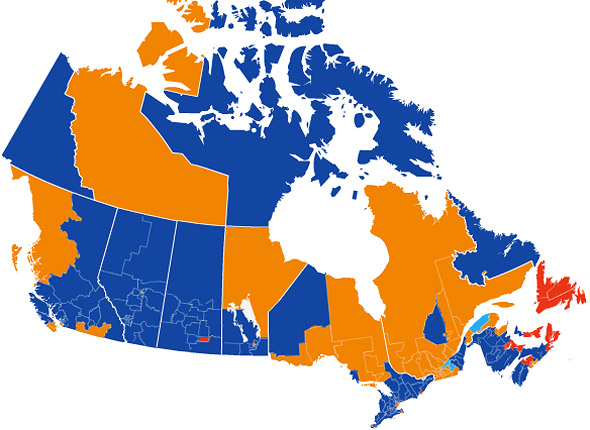
What Does Canada's Election Mean for Climate Policy?

In case you missed it, Canada just had an historic election.  Bryan Walsh asks, what it might mean for climate policy?  He gives this answer:
As it turns out, nothing very good. I'll explain why in a second, but first of all, there's something you need to know about Canada. Americans like to picture Canada as a progressive, friendly, extremely green and Kyoto Protocol-signing sort of country—and in many ways it is. But the truth is, Canada is also a petrostate. The country has 175.2 billion barrels of oil in reserves, third-most in the world, and it produces 2.6 million barrels of crude oil a day. When we think of foreign oil in the U.S., most of us imagine a Saudi sheik or a Venezuelan despot, but the single biggest supplier of foreign oil to the U.S. is our friendly neighbor to the north. And thanks to the growth of oil sands (or tar sands, depending on how polluting you consider them), petroleum and fossil fuel energy in general has only become more important to the Canadian economy, moving the country's power center to the West, where politicians like Harper hail from.

So Harper's clear victory means you can expect more industry-friendly policies from the now ruling Conservative Party, which is a little bit like Republicans-lite. That also means that Canada will continue its antagonism on the global climate stage, where it has long since abandoned any possibility of meeting its Kyoto carbon reduction targets, not that it was going to happen anyway. (Harper, back in a 2002 letter, referred to the Kyoto Protocol as a "socialist scheme.") Like his ideological counterpart George W. Bush, Harper doesn't seem to have much interest in dealing with climate change or energy, aside from the oil and gas that has helped Canada thrive recently. His position was in stark opposition to the opposition NDP, which offered more support for clean energy and—importantly—was ready to offer a carbon cap-and-trade program. But the Conservatives argued—in very familiar language—that carbon pricing would be increase energy prices and be a drag on the economy. Last night—in a possible example of what Roger Pielke Jr.'s "iron law of climate policy"—the Conservatives won, meaning that for now, carbon pricing in Canada is even less likely than it will be in the U.S.

It wasn't all bad—the fact that the Green Party now has a member in parliament puts Canada ahead of the U.S., while the NDP has proven to be a stronger green party on its own than the Liberals ever were. Harper's Conservatives may have a majority in Parliament, but they won less than 40% of the vote by number, meaning that public opinion on climate and the environment may be significantly more divided than the results suggest. And like in America, climate change and energy policy doesn't appear to have been a major issue for most voters. But there's no getting around the fact, as University of British Columbia political scientist George Hoberg blogged today:
The 2011 Canadian election is very bad news for the climate movement.
Walsh's full post is here.

02 May 2011

Financial Times on Disasters and Climate Change

I often highlight situations where the science of disasters and climate change is misrepresented. Here is a case of the opposite situation.  Today's Financial Times gets the science of disasters and climate change exactly right:
The biggest question, though, remains the extent to which climate change is the driver of hurricanes, cyclones and flooding that have hit the world with apparently increased ferocity and regularity in recent years.

It is still proving extremely difficult for scientists to extract a clear sign of the effects of climate change from the normal long-term historic cycles of weather and climate activity. That is despite simple logic saying that a warmer climate should result in more powerful storms because of a greater water content in the atmosphere.

Axel Lehmann, chief risk officer at Zurich Financial Services, says it is necessary to take a long-term perspective – of 200 or even 1,000 years.

“In terms of severity and frequency, is this type of event happening in a more systematic way? We do not yet have an answer on that,” he says.

“But on a systematic basis we do know that a growing population puts pressure on the earth and its resources.”