12 October 2009

A Cherry Picker's Guide to Global Temperature Trends

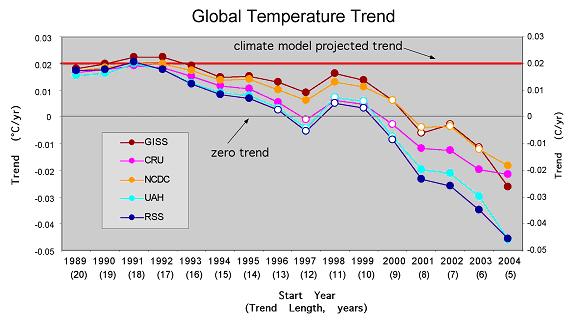
Chip Knappenberger has written an informative and fair post that clearly explains how global temperature trends look across different datasets and choice of starting dates, and which is summarized in the figure above. Here is Knappenberger's caption to the figure:
Cherry-Pickers Guide to Global Temperature Trends. Each point on the chart represents the trend beginning in September of the year indicated along the x-axis and ending in August 2009. The trends which are statistically significant (p [greater than]0.05) are indicated by filled circles. The zero line (no trend) is indicated by the thin black horizontal line, and the climate model average projected trend is indicated by the thick red horizontal line.
Based on this analysis Knappenberger calls out Real Climate and Richard Lindzen for blatant cherry picking:

Another use of my Cherry-Pickers Guide besides choosing your own analysis, is to check and see what level of cherry-picking was required to support some statement of the behavior of global temperatures that you saw somewhere.

For instance, in a recent post over at RealClimate.org, Stefan Rahmstorf used about 10-yr to 11-yr trend in the GISS dataset to support the idea that global warming was proceeding pretty much according to plan, concluding “the observed warming over the last decade is 100% consistent with the expected anthropogenic warming trend of 0.2 ÂșC per decade, superimposed with short-term natural variability.”

A quick check of my Guide would show how carefully Rahmsdorf’s selection was made. Trends a few years longer or a few years shorter that the period selected by Rahmstorf would not have borne out his conclusion with as much conviction.

Another example of careful data selection can be found in recent claims made by Richard Lindzen who is fond of stating that “there has been no statistically significant net global warming for the last fourteen years.” A quick check of my Cherry-Pickers Guide shows Lindzen to be particularly crafty because there is no support for such a statement in any of the five datasets. So how did he arrive at that conclusion? By using annual data values instead of monthly data.
Knappenberger provides some robust conclusions as well as some examples of creative cherrypicking:

Here are a few general statements that can be supported with using my Cherry-Pickers Guide:

• For the past 8 years (96 months), no global warming is indicated by any of the five datasets.

• For the past 5 years (60 months), there is a statistically significant global cooling in all datasets.

• For the past 15 years, global warming has been occurring at a rate that is below the average climate model expected warming

And here are a few more specific examples that the seasoned cherry-picker could tease out:

• There has been no (statistically significant) warming for the past 13 years. [Using the satellite records of the lower atmosphere].

• The globe as been cooling rapidly for the past 8 years. [Using the CRU and satellite records]

Or on the other side of the coin:

• Global warming did not ‘stop’ 10 years ago, in fact, it was pretty close to model projections. [Using the GISS and NCDC records beginning in 1998 and 1999]

• Global warming is proceeding faster than expected. [Using the GISS record staring in 1991 or 1992—the cool years just after the volcanic eruption of Mt. Pinatubo]

I am sure the more creative of you can probably think of many others.

First Progress Report of the UK Committee on Climate Change

The UK Committee on Climate Change has issued it first progress report (here in PDF), and here is the bottom line:
Emissions reductions in recent years have been very modest. Going forward, a step change is required if carbon budgets are to be achieved.
The report also acknowledges indirectly that looking only at emissions is misleading, because it is easy to see the recent economic slump as being some sort of success in emissions reductions, however, sometimes a slump is just a slump:
Where CO2 emissions have fallen, the extent to which this has been through implementation of measures to improve energy or carbon efficiency is very limited.
In other words, nothing has really happened in the UK economy yet to accerate decarbonization the UK economy. My analysis of the policy implications of the emissions reduction targets of the UK Climate Change Act and its implications for the rate of decarbonization of the UK economy can be found in this paper.

11 October 2009

John Kerry Hits the Reset Button

Senators John Kerry (D-MA) and Lindsey Graham (R-SC) have co-authored an op-ed in the New York Times that indicates their willingness to work together to pass climate legislation. In his usual over-the-top fashion Joe Romm sees the op-ed as clearly indicating that a bipartisan deal can be cemented in November and passage possible by December, thus flip-flopping (again) on prospects for the Senate climate bill.

However, rather than reading the op-ed as Romm has as indicating that Senator Graham has capitulated to the provisions of the Kerry-Boxer bill, another reading is that the op-ed shows that Senator Kerry is willing is hit the reset button and fashion a new climate bill in accordance to what key Republicans are willing to support. Some hint for this comes from comments from Senator Graham's office as reported by Fox News:

Sen. Lindsey Graham, R-S.C., co-authored an op-ed with Sen. John Kerry, D-Mass., in The New York Times calling for action on legislation.

Kerry rolled out a Senate climate change bill alongside Sen. Barbara Boxer, D-Calif., late last month. A Graham aide said Sunday that the South Carolina Republican was not explicitly endorsing that bill, but stands ready to work with Kerry toward some version of legislation to combat global warming.

What does the op-ed suggest that Senator Kerry is willing to add or change in the bill? Here are some thoughts, based on excerpts from the op-ed:

We will minimize the impact on major emitters through a market-based system that will provide both flexibility and time for big polluters to come into compliance without hindering global competitiveness or driving more jobs overseas.

Flexibility and time are code words for tradeoffs with emissions reductions targets and timetables. The fact that no numbers are provided in the op-ed indicates from both authors a willingness to negotiate. As Senator Barbara Boxer (D-CA) recently explained, the 20% reduction target for 2020 is a "high-water mark." Flexibility combined with the idea of competitiveness and jobs implies that provisions like offsets and safety valves will be in ample supply, so that even agreed-upon targets and timetables may not mean what they say they mean.

Nuclear power needs to be a core component of electricity generation if we are to meet our emission reduction targets. We need to jettison cumbersome regulations that have stalled the construction of nuclear plants in favor of a streamlined permit system that maintains vigorous safeguards while allowing utilities to secure financing for more plants. We must also do more to encourage serious investment in research and development to find solutions to our nuclear waste problem.

While the provisions of a nuclear title to the bill are uncertain, there are some in the environmental community who are not going to like the idea of making it easier to build nuclear power plants (see, e.g., the NRDC position here in PDF).

For too long, we have ignored potential energy sources off our coasts and underground. Even as we increase renewable electricity generation, we must recognize that for the foreseeable future we will continue to burn fossil fuels. To meet our environmental goals, we must do this as cleanly as possible. The United States should aim to become the Saudi Arabia of clean coal. For this reason, we need to provide new financial incentives for companies that develop carbon capture and sequestration technology.

In addition, we are committed to seeking compromise on additional onshore and offshore oil and gas exploration. . .
A climate bill that opens up new offshore drilling and guarantees the future of coal mining, coal burning and coal waste?! I expect that many environmentalists are going to have to swallow hard to accept these provisions, and I'd bet on hearing some push back from that community (too bad for them because the legislation isn't much about the environment anymore). Since CCS doesn't even exist yet at scale it is remarkable to see Senator Kerry willing to bet emissions reductions success on a technology that requires significant technological innovation (Romm, who strongly opposes both CCS and the idea that technological innovation may be necessary, is strangely mute on the call for a massive commitment to a coal-fired future in the bill). It would be quite a coup, and bizarrely ironic, if Republicans can use the climate bill to ensure a fossil-fueled future for U.S. energy supply.
. . . we should consider a border tax on items produced in countries that avoid these standards . . .
This sort of talk will play well in the heartland, but is against the stated preferences of the Obama Administration and would be a deal breaker in international negotiations. If a bill does pass the Senate with such a provision (unlikely I'd guess) it would be very interesting to see what President Obama does to avoid a trade war. But I doubt it would get that far, based on the phrase "we should consider" in the op-ed.
. . . we will develop a mechanism to protect businesses — and ultimately consumers — from increases in energy prices. The central element is the establishment of a floor and a ceiling for the cost of emission allowances. This will also safeguard important industries while they make the investments necessary to join the clean-energy era. We recognize there will be short-term transition costs associated with any climate change legislation, costs that can be eased.
No surprise here, and nothing new. The costs of any such legislation, by definition, will not be high, even if that means gutting the bill's intended purpose.
Failure to act comes with another cost. If Congress does not pass legislation dealing with climate change, the administration will use the Environmental Protection Agency to impose new regulations. Imposed regulations are likely to be tougher and they certainly will not include the job protections and investment incentives we are proposing.
This threat is hollow. Like the Obama Administration is going to tank the economy? This sort of talk just emboldens Republicans to call the bluff by obstructing Senate action and seeing what happens in the months leading up to the 2010 mid-term elections.

What is missing in the op-ed? Well, among a few other things, any mention of the phrase "cap and trade." Senator Kerry recently said that he didn't know what that phrase meant and called the bill a pollution reduction bill. Now it seems to be about energy independence, jobs and the environment.

Overall, my judgment is that the Kerry-Graham collaboration represents a major stepback by the Democrats, who are showing a desire to pass something -- anything -- related to climate. Such a stance does not put the Democrats in a strong negotiating position. If my analysis is close to the mark, you can expect more concessions from the Democrats on a regular basis as the legislation moves forward.

09 October 2009

Somtimes Bad News Come Out Late on a Friday

From Greenwire, not a surprise, but interesting nonetheless:
As the U.N. climate talks in Bangkok wound down today, the chief U.S. negotiator acknowledged that the United States may not agree to cut greenhouse gas emissions in a treaty this year until Congress passes its climate legislation.

"It will be extraordinarily difficult for the U.S. to commit to a specific number in the absence of action from Congress," State Department deputy climate envoy Jonathan Pershing said. "The question is open as to how much we can do. It's not really possible to answer."
UPDATE: And this view from Europe:
Obama’s scope is limited because the U.S. Congress may not approve a domestic law to control emissions before the December deadline for signing an international climate accord in Copenhagen, Karl Falkenberg, director-general for environment at the European Union’s executive body, said in an interview.

“Obama and his administration are very committed, and it will be more than an embarrassment for them if at Copenhagen they would have to admit they are not ready,” Falkenberg said late last night in Bangkok, where more than 180 nations are meeting for talks. “We can just help, but helping them also means directly telling them that the world has an expectation.”

A Message from the UK Government

From the UK government's Department of Energy & Climate Change, a new media campaign on climate change.

The "Shameful Article": A Review and Update

As the world continues to suffer a "depression" in global tropical cyclone activity with activity at 30-year lows, and hurricane forecasters try to keep busy while watching the listless Atlantic, I thought that for those who haven't been reading this blog for the past 5 years (which I assume is most everyone;-) it would be worth reviewing a bit of the history of the science on hurricanes and global warming, and how that science was ignored by the IPCC.

In 2004 and 2005 (before Katrina), I led an interdisciplinary effort to review the literature on hurricanes and global warming. The effort resulted in a peer-reviewed article in the Bulletin of the American Meteorological Society (here in PDF). Upon its acceptance Kevin Trenberth, a scientist at NCAR here at Boulder and the person in charge of the 2007 IPCC AR4 chapter that reviewed extreme events including hurricanes, said this in the Boulder Daily Camera (emphasis added) about our article:
I think the role of the changing climate is greatly underestimated by Roger Pielke Jr. I think he should withdraw this article. This is a shameful article.
Here is what the "shameful article" concluded:
To summarize, claims of linkages between global warming and hurricane impacts are premature for three reasons. First, no connection has been established between greenhouse gas emissions and the observed behavior of hurricanes . . . Second, the peer-reviewed literature reflects that a scientific consensus exists that any future changes in hurricane intensities will likely be small in the context of observed variability . . . And third, under the assumptions of the IPCC, expected future damages to society of its projected changes in the behavior of hurricanes are dwarfed by the influence of its own projections of growing wealth and population . . . While future research or experience may yet overturn these conclusions, the state of the peer-reviewed knowledge today is such that there are good reasons to expect that any conclusive connection between global warming and hurricanes or their impacts will not be made in the near term.
When Trenberth called the article shameful I responded on Prometheus with this comment:

Upon reading Kevin’s strong statements in the press a few weeks ago, I emailed him to ask where specifically he disagreed with our paper and I received no response; apparently he prefers to discuss this issue only through the media. So I’ll again extend an invitation to Kevin to respond substantively, rather than simply call our paper ’shameful’ and ask for its withdrawal (and I suppose implicitly faulting the peer review process at BAMS): Please identify what statements we made in our paper you disagree with and the scientific basis for your disagreement. If you’d prefer not to respond here, I will eagerly look forward to a letter to BAMS in response to our paper.

Climate change is a big deal. We in the scientific community owe it to the public and policy makers to be open about our debates on science and policy issues. We’ve offered a peer-reviewed, integrative perspective on hurricanes and global warming. I hold those with different perspectives in high regard — such diversity makes science strong. But at a minimum it seems only fair to ask those who say publicly that they disagree with our perspective to explain the basis for their disagreement, instead of offering up only incendiary rhetoric for the media. Given that Kevin is the IPCC lead author responsible for evaluating our paper in the context of the IPCC, such transparency of perspective seems particularly appropriate.
Not surprisingly the IPCC chapter that Trenberth led for the IPCC made no mention of our article, despite it being peer reviewed and being the most recently published review of this topic prior to the IPCC publication deadline (the relevant IPCC chapter is here in PDF). Even though the IPCC didn't see the paper as worth discussing, a high-profile team of scientists saw fit to write up a commentary in response to our article in BAMS (here in PDF) . One of those high-profile scientists was Trenberth. Trenberth and his colleagues argued that our article was flawed in three respects, it was,
. . . incomplete and misleading because it 1) omits any mention of several of the most important aspects of the potential relationships between hurricanes and global warming, including rainfall, sea level, and storm surge; 2) leaves the impression that there is no significant connection between recent climate change caused by human activities and hurricane characteristics and impacts; and 3) does not take full account of the significance of recently identified trends and variations in tropical storms in causing impacts as compared to increasing societal vulnerability.
Our response to their comment (here in PDF) focused on the three points that they raised:
Anthes et al. (2006) present three criticisms of our paper. One criticism is that Pielke et al. (2005) “leaves the impression that there is no significant connection between recent climate change caused by human activities and hurricane characteristics and impacts.” If by “significant” they mean either (a) presence in the peer-reviewed literature or (b) discernible in the observed economic impacts, then this is indeed an accurate reading. Anthes et al. (2006) provide no data, analyses, or references that directly connect observed hurricane characteristics and impacts to anthropogenic climate change. . .

In a second criticism, Anthes et al. (2006) point out (quite accurately) that Pielke et al. (2005) failed to discuss the relationship between global warming and rainfall, sea level, and storm surge as related to tropical cyclones. The explanation for this neglect is simple—there is no documented relationship between global warming and the observed behavior of tropical cyclones (or TC impacts) related to rainfall, sea level, or storm surge. . .

A final criticism by Anthes et al. (2006) is that Pielke et al. (2005) “does not take full account of the significance of recently identified trends and variations in tropical storms in causing impacts as compared to increasing societal vulnerability.” Anthes et al. (2006) make no reference to the literature that seeks to distinguish the relative role of climate factors versus societal factors in causing impacts (e.g., Pielke et al. 2000; Pielke 2005), so their point is unclear. There is simply no evidence, data, or references provided by Anthes et al. (2006) to counter the analysis in Pielke et al. (2000) that calculates the relative sensitivity of future global tropical cyclone impacts to the independent effects of projected climate change and various scenarios of growing societal vulnerability under the assumptions of the Intergovernmental Panel on Climate Change.
This series of exchanges was not acknowledged by the IPCC even though it was all peer-reviewed and appeared in the leading journal of the American Meteorological Society. As we have seen before with the IPCC, its review of the literature somehow missed key articles that one of its authors (in this case Trenberth, the lead for the relevant chapter) found to be in conflict with his personal views, or in this case "shameful." Of course, there is a deeper backstory here involving a conflict between my co-author Chris Landsea and Trenberth in early 2005, prompting Landsea to resign from the IPCC.

So almost five years after we first submitted our paper how does it hold up? Pretty well I think, on all counts. I would not change any of the conclusions above, nor would I change the reply to Anthes et al. Science changes and moves ahead, so any review will eventually become outdated, but ours was an accurate reflection of the state of science as of 2005. However, you won't find any of this in the IPCC.

Papers and links

Anthes et al. 2006, Hurricanes and global warming: Potential linkage and consequences, BAMS, Vol. 87, pp. 623-628.

Pielke, Jr., R. A., C. Landsea, M. Mayfield, J. Laver and R. Pasch, 2005. Hurricanes and global warming, Bulletin of the American Meteorological Society, 86:1571-1575.

Pielke, Jr., R. A., C.W. Landsea, M. Mayfield, J. Laver, R. Pasch, 2006. Reply to Hurricanes and Global Warming Potential Linkages and Consequences, Bulletin of the American Meteorological Society, Vol. 87, pp. 628-631, May.
United States hurricane landfalls and damages: Can one-to five-year predictions beat climatology?

My paper on one to five year hurricane predictions is now out and you can find it here in PDF. Here is the abstract:
This paper asks whether one- to five-year predictions of United States hurricane landfalls and damages improve upon a baseline expectation derived from the climatological record. The paper argues that the large diversity of available predictions means that some predictions will improve upon climatology, but for decades if not longer it will be impossible to know whether these improvements were due to chance or actual skill. A review of efforts to predict hurricane landfalls and damage on timescales of one to five years does not lend much optimism to such efforts in any case. For decision makers, the recommendation is to use climatology as a baseline expectation and to clearly identify hedges away from this baseline, in order to clearly distinguish empirical from non-empirical justifications for judgments of risk.
Pielke, Jr., R.A., 2009. United States hurricane landfalls and damages: Can one-to five-year predictions beat climatology?, Environmental Hazards, Vol. 8, pp. 187-200.

08 October 2009

Mamizu Climate Policy Analysis Now Online

My paper on Japan's emissions reduction targets is now online at IOP here. EnvironmentalResearchWeb has a news story on the paper and a few additional comments from me, including a hint of something upcoming.

Is Belief in Climate Change a Religion?

Is belief in climate change a religion? The answer is "yes" for Tim Nicholson in the UK, who according to the Guardian "is attempting to have his environmental views recognised under religious law" in order to claim wrongful dismissal from a job. He claims that the firm fired him due to his beliefs about climate change. Here are some more details:

In March, employment judge David Neath gave Nicholson permission to take the firm to a tribunal over his treatment. The company is challenging the ruling, arguing that environmental beliefs are not the same as religious or philosophical ones.

Nicholson, from Oxford, said his views – which compelled him to make his home more eco-friendly and do not allow him to fly – affect his entire life. In a witness statement to the previous hearing, he said: "I have a strongly-held philosophical belief about climate change and the environment. I believe we must urgently cut carbon emissions to avoid catastrophic climate change."

He stopped working for Grainger as head of sustainability in July last year, having been at the company since June 2006. At an employment appeal tribunal in central London today, Dinah Rose QC, for Nicholson, said: "The philosophical belief in this case is that mankind is headed towards catastrophic climate change and that, as a result, we are under a duty to do all that we can to live our lives so as to mitigate or avoid that catastrophe for future generations.

"We say that that involves a philosophical and ethical position. It addresses the question, what are the duties that we own to the environment and why?"

She told Mr Justice Michael Burton – who ruled last year that Al Gore's environmental documentary An Inconvenient Truth was political and partisan – that beliefs about "anthropogenic climate change" could be considered a philosophy under the Employment Equality (Religion and Belief) Regulations 2003.

John Bowers QC, representing Grainger, said Nicholson's views were based on scientific fact and were predominantly political. "We would say that because it is political, it is dealing with an assertion of fact," he said. "It is a scientific view rather than a philosophical one. Philosophy deals with matters that are not capable of scientific proof."

While the case itself will hinge on particulars of UK law and jurisprudence, the questions for readers here are less technical. What does it mean to say that "belief in climate change" is philosophical or religious or scientific? Should people who change their lifestyles based on their beliefs about climate change be protected under the same laws that protect freedom of religion? Does science tell us what philosphical or religious beliefs are valid?

Paging Ben Hale . . . ;-)

UPDATE: Ben's pager was apparently on this morning

07 October 2009

Chong's Bongs and Laplace's Demons

From Dan Sarewitz over at CSPO Soapbox:
In 2003, Tommy Chong, a comedian who made a career out of acting (and presumably being) stoned, got sent to federal prison for nine months for illegally selling beautiful custom-made blown-glass bongs ( “drug paraphernalia”) over the Internet. The story is told in a surprisingly understated and affecting documentary entitled “aka Tommy Chong,” which came out a few years ago and just recently made it to my TV screen via Netflix (that miracle of converging information, communication, and transportation technologies).

Anyway, what I want to focus on here is the government rationale for busting Chong, because it pertains to many difficult social problems. DEA had to go to extraordinary gyrations (spending millions of dollars in the process) to entrap Chong (who was the prime investor in his son’s small boutique bong business). Then the helicopters and SWAT teams got to swoop in on Chong’s house and his little glass-blowing factory to ensure that no one would get hurt. The Justice Department also ensured that Chong would cop a plea and do jail time, rather than go to trial, by threatening to indict his wife and son if he didn’t plead guilty. Of course this kind of miscarriage goes on all the time. What’s really incredible is the skein of logic that the U.S. Attorney used to publicly justify Chong’s high-profile prosecution: by selling drug paraphernalia, Chong was supporting terrorism. After all, terrorist groups like Al Qaeda bankroll their operations in part by producing and selling opium and other illegal drugs, and such drugs require various tools for preparation and consumption, so those who provide such tools are key elements of the terrorist infrastructure. Chong’s bong business was supporting our most dangerous enemies, and he was morally accountable for terrorist attacks. Get it?

Gee, that reminds me of something else I just read (thanks to Thad Miller alerting me to this) on ClimateEthics.org, a Web site sponsored by Penn State University’s Rock Ethics Institute: “We now know from climate change science that people consuming a large amount of fossil fuel derived energy in some developed countries are already contributing to death and sickness in Africa, South Asia, and threatening residents of small island states in the Pacific . . . For instance, a village vulnerable to climate change impacts may be at risk because of unique local geographical features such as where the village is located in relation to upstream steep topographical slopes while being in a part of the world where more intense storms are predicted. . . And so those causing climate change are causing great harm to others . . . [E]thics unequivocally requires that those harming others stop the behavior causing great harm.”

My guess is that one could make pretty robust predictions about the ideological preferences of someone who believes that if you sell bongs, you are morally accountable for supporting terrorism, versus someone who thinks that if you drive a car you are morally accountable for killing poor people on other continents. Okay fine, but what about the CO2 emissions from bongs? What about the sponsorship of terrorism by nations that provide fuel for your car? I prefer my ethical responsibilities tied to simpler cause-effect chains. Otherwise aren’t we all guilty of everything?


Is China's Energy Intensity Story a Myth? Part II

I raised this question in an earlier post, suggesting from international statistics that China's energy intensity has improved only by 7.4% since 2005, rather than larger figures more commonly referenced based on data from the Chinese government.

Now, Julian Wong from the Center for American Progress points us to an analysis that he published on his blog showing substantially similar figures using another set of data. With that data the analysis concludes that:
[China's] energy intensity drop for the three year period 2006-2008 is only 7.7%, not the 10% commonly reported.
Before pointing us to the guest post Julian tells us in the comments that;
China’s goal is to reduce energy intensity (energy consumption per unit of GDP) by 20% of 2005 levels by 2010. According to its own reports, China has made steady progress in achieving that (it is now at -13.4% of 2005 levels), but because GDP has continued to grow by 8 to 10% over the last few years, absolute emissions have increased.. . the main implication of my point is that while China has done a lot, it will need to do more going forward.
I responded by encouraging Julian to share the broader context of China's "fuzzy math" with his readers over at CAP, it seems like an important part of the story that is too often left out of CAP analyses.

Are WRI and ExxonMobil in Agreement on a Carbon Price?

UPDATE: John Larsen responds in the comments He helps to resolve the units question I raised in Comment #1, and indicates that despite his obvious distaste of the thought, WRI and ExxonMobil share similar views on a starting price on carbon.

In an interview last week John Larsen of the World Resources Institute says that a starting $10 per ton price on carbon is a "sufficient price":
ACES essentially sets a price floor on allowances of $10, which will ensure that a sufficient price on carbon is established even if demand is low.
A price on carbon of $10/ton is $10 per ton less than that which has been called for by Rex Tillerson, CEO of ExxonMobil earlier this year:
Rex W. Tillerson, the chairman and chief executive of ExxonMobil Corp., delivered a speech in Washington yesterday endorsing a carbon tax of about twenty dollars per ton as a better way to address global warming than the principal alternative-policy idea, known as a cap-and-trade system, which has already been adopted in Europe.
So lets get this straight . . . WRI thinks that a carbon price half of that called for by ExxonMobil is "sufficient" -- at least to start -- and we are arguing over an incredibly complex cap-and-trade program, which probably won;t pass anytime soon and if it does, has more ways to avoid the carbon price than you can imagine. The question that comes to mind is, why?

Why not simply pass a $10 per ton carbon tax, which now seems uncontroversial, and then argue about how fast to increase it and how to (re)distribute the revenue? If I weren't in such a charitable mood I'd probably suggest something cynical, like cap and trade not being about a carbon price after all.

Some Charity to CAP

UPDATE: Julian Wong explains in the comments.

My friend and colleague Ben Hale tells me that we political scientists are trained to be cynical whereas philosophers like him are trained to be charitable. Maybe so. Here is an attempt at a charitable reading of a perspective attributed to a climate expert at the Center for American Progress:
Julian Wong, a senior energy policy analyst at the Center for American Progress, noted that energy efficiency, while all well and good, doesn't alone influence a country's absolute emissions.
A charitable reading of this is that Mr. Wong was horribly misquoted mis-paraphrased. Because as everyone knows, energy efficiency does indeed alone influence a country's absolute emissions. In fact, energy efficiency is really only one of two levers that we have to influence emissions, the other is carbon intensity of energy supply. So Mr. Wong should act quickly to correct the apparent misquote mis-paraphrase, as less charitable readings would all but certainly conclude that with perspectives like that, CAP doesn't really know what it would take to decarbonize the global economy.

06 October 2009

Korholas on Climate Policy

The piece below was published in the Finnish newspaper Helsingin Sanomat during summer 2008 and is by Atte Korhola, professor of environmental change at the University of Helsinki, and Eija-Riitta Korhola, a Member of the European Parliament (pictured to the right). Atte received a bit of unexpected attention over at Climate Audit when some comments that he made in Finnish on a Finnish discussion site were taken friom a longer piece and translated and posted by a Finnish-speaking Climate Audit regular (small world!). Atte and I are collaborators, having worked together on a recent white paper, How to Get Climate Policy Back on Course (Prins et al., 2009, here in PDF).

I thought that it might be worthwhile to share some of the Korholas' very thoughtful views on climate policy, which are well known in Finland, but much less so in the United States. Thanks to Atte for the English translation of the following piece which appeared originally in Finnish.
Environmental organizations’ climate policy a series of miscalculations

08.06.2008
Environmental organizations are generally considered experts in preventing climate change although many of their solutions have proved downright destructive, write Atte Korhola and Eija-Riitta Korhola.


Cimate warming greenhouse-gas emissions are increasing much faster than expected; in the 1990s carbon dioxide emissions increased annually by more than 1%, whereas in the 2000s their increase rate is 3.3 %.

A recent article in the Nature magazine claims that the Intergovernmental Panel on Climate Change, IPCC, (that received a Nobel prize for its work) has in fact underestimated the growth rate of carbon dioxide emissions. Particular attention has been paid to the fact that while the carbon intensity of national economies was expected to decrease naturally until now, it is, in fact, increasing.

As desperately as we need efficient measures to control the climate change, it is equally important to choose the right measures, measures that will improve the condition of the atmosphere and, at the same time, are economically viable.

Politicians, energy producers, and industries can well be criticized of narrow-mindedness in their views. However, environmental organizations, such as Greenpeace, WWF, Friends of the Earth, and the Finnish Association for Nature Conservation are usually seen as forerunners in environmental matters. As their views often have a considerable impact on climate policy, it is time to examine the solutions they offer critically.

As far as climate change prevention is concerned, the solutions that environmental groups favour are beginning to look out of date and inadequate – and often downright destructive to the environment.

One example is the fact that these organizations opposed the inclusion of carbon dioxide sinks, such as tropical forests, and reforestation to the Kyoto Protocol as a form of carbon offset. They justify their opposition by the fact that, for them, decreasing emissions is the primary target. It was only in the UN Climate Change Conference in Bali last year that controlling deforestation and increasing forest restoration were accepted as means of controlling climate change, mainly thanks to developing countries.

Considering that as much as 20 % of human-induced greenhouse gas emissions come from logging tropical forests, decreasing deforestation is one of the most powerful tools in combating climate change. In addition to increasing deforestation, opposition from the environmental organizations also delivered a blow to developing countries: they were denied any economic incentives to preserve their forests.

For a long time, these organizations also opposed all measures aimed at adapting to climate change, as they saw climate change, as something that should be stopped, not adapted to.

Only recently have environmental organizations started to accept the idea that it is too late to stop climate change completely, and that political measures should also be aimed at preparative actions. Both are necessary: emissions must decrease for the sake of future generations, and adaptation to change for the sake of current generations. Delays may already have resulted in worsening living conditions as well as destroying nature and extinction of some species, especially in developing countries. Dogmatism based on ideals has already cost too many lives, particularly in the poorest countries.

Similar dogmatism is common in the views of environmental groups; they are against using waste as a source of energy as they believe it will deter preventing the generation of waste. They also oppose developing nuclear fission and fusion energy, as they are afraid it will increase energy consumption and slow down the development of renewable forms of energy.

Environmental organizations supported the increased use of field energy and bio fuels for a long time, as can be seen in their vision from 2006: “Climate target 2050: paths to low-emission society”. However, the side effect of the bio fuel boom it created was gloomy, and, once again, the victims were the poorest countries: world market prices of many basic foods have doubled or even tripled during the last three years – mainly due to increased demand of bio fuels.

According to a recent article published in Science magazine, it would take 400 years to pay off the global “carbon debt” caused by changes in land use induced by field energy production.

The concern environmentalist groups are showing now, about the sufficiency of bio fuels and the environmental hazards created by the ever-growing palm oil production in particular, is unfortunately late.

More unfortunate mistakes: accepting to increase renewable energy sources in a tight time frame without criticism may drive Finland and the whole of Europe into large-scale wood burning, the environmental impacts of which – in addition to the poor energy balance of log burning– can be ecologically unpredictable. In addition to these hazards, decentralized wood burning may increase the number of deaths caused by fine-particle emissions in Europe, which is already considerable.

Although the share of wood biomass in our energy production can be increased considerably, one would expect to hear the environmental groups’ views on the risks excessive felling can cause to the wellbeing of forests. According to a study carried out by the UN Economic Commission for Europe (ECE), UN Food and Agriculture Organization (FAO), and the University of Hamburg, wood consumption will be 453 million cubic metres in 2020 due to bio energy targets, and there will be a demand-supply gap that is eight times as big as the amount of annual tree felling in Finland.

Another irrevocable change in landscape will be threatening Finland’s unique archipelago if wind energy production is increased as much as the environmental organizations want. It would be short-sighted to promote such changes, especially as technologies are likely to offer ecologically more subtle and, at the same time, more durable solutions in the near future

Therefore it is amazing that these organizations have taken a very negative view against developing such new technologies as fusion power, fuel cell technology, hydrogen economy, and clean coal technology when, in the long run, these new energy systems will be crucial in controlling climate change.

It is necessary to develop the recovery and storage of carbon dioxide, as, according to current forecasts, two thirds of world’s energy will continue to be produced by fossil fuels until the mid century. Several new coal plants are being built in Europe, particularly in the countries that prefer wind power.

Using clean coal is necessary particularly in China whose main power source are still coal plants, the emissions of which in 2030 are estimated to be equal to those of the whole world now.

According to every climate and energy survey, technology faces bigger challenges than expected: creating new energy solutions takes up so much resource, it is equal to many Marshall aids. A quick metamorphosis into a zero-emissions society cannot be achieved by imposing bureaucratic and strict laws and regulations, or by increasing the use of renewables alone.

According to the Intergovernmental Panel on Climate Change, IPCC, it is necessary to put every efficient solution into use in order to control the climate change quickly. Energy must be saved, its use be more efficient, and the allocation of renewables must be increased. At the same time, in order to mitigate the amount of emissions we need clean-coal power, modern nuclear power, and, above all, new energy sources need to be developed.

Environmental organizations could play an active role in promoting these alternatives instead of promoting measures that can only lead to the irrevocable destruction of the environment and nature, as they are doing now. Amidst the enormous growth in emissions and discharges, these organizations are like mess boys on The Titanic, more worried about the cleanliness of the deck than the approaching iceberg.

In summary, the role of environmental groups should be clarified. Instead of just listening to their opinions, society often assumes they are the experts, a role that both the press and politicians alike seem to take for granted. However, recognizing and localizing problems does not automatically mean competence nor proficiency in solving them.

Atte Korhola is a Professor of Environmental Change at the University of Helsinki

Eija-Riitta Korhola is a Member of the European Parliament in the Committees for Environment and Climate Change

Revkin Pushes Back: Should Journalists Ape Activist Bloggers?

One interesting trend of the internet era is the degree to which prominent journalists (and also academics) are subject to intense political lobbying of the sort that historically has been primarily in the domain of public officials. Sure, there have always been letters to the editor, angry calls to the newspaper and the occasional advertiser boycott, but I'd argue that the internet changes these dynamics, by making pressure campaigns more easily undertaken and more public.

The best example of this in the climate domain is the incessant hectoring of Andy Revkin, a prominent reporter who covers environment at the New York Times, by Joe Romm, a political activist and blogger at the Center for American Progress, who spews forth all sorts of angry, half-thought-through diatribes when Revkin does not celebrate Joe or his political views. The point, Joe's ego aside, is to increase political pressure on Revkin to take certain actions and reflect certain perspectives.

Consider Romm's marching orders to the media not to talk with me or Michael Shellenberger and Ted Nordhaus at The Breakthrough Institute. Of course, Joe feels no need to follow his own orders, citing me, Michael and ted dozens upon dozens of times. The point of course is simple -- Joe wants to try to control the focus of attention and have a forum to himself to advocate. Pressuring the media not to cover people who disagree allows him to sidestep the substantive issues that he is generally very weak on, and instead shape debate by bluster and intimidation. Amazingly, some reporters actually follow Joe's directives. Most others do not. But the intense lobbying makes reporters no different than politicians subject to pressure campaigns. And for journalists, like politicians -- some give in to the pressure, others show leadership.

Yesterday, Andy Revkin pushed back hard to this sort of pressure on his blog when an activist took him to task for mentioning Steve McIntyre. Here is what Revkin said:
So Mr. McIntyre is a sufficiently substantive presence for the scientists at http://www.Realclimate.org to refute, and for Thomas Crowley to challenge, and for the National Academies to assess ( http://www.nytimes.com... ).

But if I write a blog post about his decision not to pursue publication of his own temperature time series, I'm illegitimate or something. You, like some others here, seem to want journalists to ape activist bloggers whose response to opposing voices -- however legit or suspect -- is to place hands over ears and say, "I can't hear you, I can't hear you... "
Is media coverage in climate going the way of aping activist bloggers? Or will there remain a place for more traditional coverage? Does it matter?

Minor Errata in Pielke (2009)

Not caught in proof stage, and too late to change, so I make note of it here. In my paper Pielke, Jr., R. A., 2009. The British Climate Change Act: A Critical Evaluation and Proposed Alternative Approach, Environmental Research Letters, Vol. 4, No. 2. At two places I mention "energy production." In both instances it should instead be "energy consumption."

05 October 2009

Planned Economic Recession: Why Didn't I Think of That?

In my recent paper on the UK Climate Change Act I argued that:
Given the magnitude of the challenge and the pace of action, it would not be too strong a conclusion to suggest that the Climate Change Act has failed even before it has gotten started.
But apparently there is one policy option that I failed to consider: planned economic recession. From the UK Telegraph:

At the moment the UK is committed to cutting greenhouse gases by a third by 2020.

However a new report from the Tyndall Centre for Climate Change Research said these targets are inadequate to keep global warming below two degrees C above pre-industrial levels.

This would mean reducing the size of the economy through a "planned recession".

Kevin Anderson, director of the research body, said the building of new airports, petrol cars and dirty coal-fired power stations will have to be halted in the UK until new technology provides an alternative to burning fossil fuels.

Planned recession. That is sure going to help sell action on climate change.

Clive Crook on Political Rage

Clive Crook's column in the FT today is 100% on target. Here is an excerpt:

Increasingly, rage is the dominant mood of US politics – but the feeling is not confined to the far right. Committed partisans on both sides question their opponents’ legitimacy. It is one thing for an adversary to be mistaken, quite another to be a liar or traitor. You do not argue with an opponent like that, or seek an accommodation. You silence him, you shout him down, you impeach.

Right-wing “birthers” question whether Mr Obama was born in the US and can lawfully be president. Their leftwing counterparts think George W. Bush stole the 2000 election, then permitted the attacks of 9/11 to justify his war against Iraq and the creation of a police state. Conservatives deride Mr Obama’s healthcare plan as a plot to turn the US socialist. Liberals, led by former president Jimmy Carter, no less, suggest that much of the opposition to Mr Obama is mere racism.

On substance, there is no discussion. Opponents’ views are not worth examining; bad faith goes without saying. In effect, each side questions the other’s right to participate.

To repeat, this is an attitude of the politically committed, not representative of the country as a whole. Indeed, most Americans’ disgust at the relentless anger and ill will helps to explain their disenchantment with politics.

Crook's analysis applies well to the climate debate:

But one wonders whether even more may be at stake than the capacity to form sound and steady policy. So inflamed are the US political classes that a deeper breakdown begins to be imaginable.

Historically, the US has both accommodated and benefited from a remarkable degree of cultural pluralism – with sufficient civic tolerance, mutual (if sometimes grudging) respect and unashamed patriotism to bind the whole together. Now, more than ever, the instinct of politicians and their energised supporters is to divide. Mr Obama seemed to promise a corrective, but that hope is fading. Old and new media, obsessed with gladiatorial politics, offer no remedy. They either take sides or act as fight promoters; in any event they worsen the polarisation and leave the centre unserved. The internet’s echo chambers stir brainless anger and push the poles still further apart.

In the coming years, the US has enormous challenges to face – not least, like Britain before it, the trauma of relative economic decline. Right now, its polity looks unfit to cope. “A house divided against itself”, said Abraham Lincoln, “cannot stand.”

Quote of the Day

A belief is not scientific because it has been “proved” but because it is continuously tested, and tested by conformity to experience rather than to axiomatic truths.

Abraham Kaplan, 1958

CAP's Move to the Right

The image above shows Al Gore on a two trillion dollar bill, he is holding a wrench and a compact florescent light bulb. the text says “Corporate Giveaways! Carbon Ponzi Schemes! FALSE SOLUTIONS!”

What is this? A creation of right wing "deniers" perhaps? No it is not.

It is part of a campaign by what Grist calls "far left" groups to point out that the cap and trade legislation being considered by the U.S. Congress is a sham. These "far left" groups are environmental organizations that count among their supporters NASA's James Hansen. Here is what the Center for American Progress's head of climate strategy Daniel Weiss says about these "far left" groups:

“It’s troubling. No one believes that the clean energy bill that will come out of Congress will address the threat of global warming in a single step. But we have to start. The real enemies are Big Oil and Big Coal and the right wing attack machine. For them to mock [Gore] in the way they did shows that they don’t understand you need to attack your enemies and not your allies.”

Weiss does not seem to realize that for these groups CAP and Gore are the enemy, hence the campaign against them. Weiss says of Hansen's role in particular:
“If they hear from such a respected scientist as James Hansen that what Congress is doing won’t matter, then why would they bother to call their senators to say ‘Act on this’?”
Why indeed? Weiss did not address whether Hansen's critique of the legislation is on target or not.

An irony here is that not so long ago CAP was in the same camp as these "far left" groups. Here is what CAP's Joe Romm wrote last January about the framework for the Waxman-Markey/Kerry-Boxer bills (emphasis in original):
. . . this proposal would be wholly inadequate as a final piece of legislation. As a starting point it is unilateral disarmament to the conservative politicians and big fossil fuel companies who will be working hard to gut any bill. . . Shame on my NRDC and EDF and WRI friends for signing on to such nonsense. . . [The] plan would call for a reduction of 1.0 to 1.4 billion tons of U.S. GHGs in 2020, while allowing 2 billion or more tons of offsets, at least half of which don’t even have to be in this country. When would US carbon dioxide emissions see serious reductions under this plan? Who knows?

No serious environmental group — no person or group serious about keeping total global warming as close as possible to 2°C, no one who endorses a target of 450 ppm or lower, should endorse a final climate bill with more than, say, 5% very high quality offsets allowed. . .

This proposal is a dead end — and an even deader starting point. Shame on NRDC, EDF, and WRI for backing it.
So I suppose that we can conclude that CAP's new-found love of the Waxman-Markey approach can be characterized as a move to the right, leaving behind those "far left" groups?

As we have seen in the defections from the U.S. Chamber of Commerce of a number of businesses opposed to their anti-action agenda, cap and trade is tearing at the seams of the environmental community as well. With luck, all of this realignment will lead to a fresh approach to climate policy. One can only wish.

H/T Keith Kloor

Evaluating Scientific Arguments Using Political Criteria

Of course evaluating scientific arguments according to their perceived political implications happens all the time, but rarely do you see a scientist admitting as much publicly. Here is Wally Broecker explaining one reason why he rejects Warren Ruddiman's peer-reviewed work on the possibility that early humans influenced climate in discernible ways:
"I think it's a bunch of bosh," said Wallace Broecker, a professor at Columbia University. Broecker said he worried that the idea of pre-modern people as carbon emitters would turn into an argument that the modern world need not worry so much about its own pollution. "I get really upset with him because people who oppose global warming (legislation) can use this as some dodge."

Better Come Prepared

UPDATE: Dot Earth on the debate.

If you want to know why Steve McIntyre has a large following and the respect (often begrudging) from many professionals, you need look no further than his latest post on the Yamal controversy. Some people won't like his tone and others won't like how his work is used and spun in the political process. All fair complaints, but they are largely a side show to the substantive issues. And so long as Steve is delivering detailed, systematic and devastating substantive arguments -- and yes this post is all three -- he will continue to have a following and earn respect (however begrudging).

Anyone coming to this fresh who compares McIntyre's latest dissection with the recent screed from Real Climate will come to a similar judgment, I'd guess. I stand by my unsolicited advice to McIntyre that he needs to publish his work in the peer reviewed arena if he wants to have his work accepted and included in the mainstream scientific discourse. Meantime, those professionals, such as the guys at Real Climate, who want to do public battle over scientific issues on the blogs had better step up their game, because no matter how much the blog chorus gets whipped up about the tribal aspects of the debate, fair minded people observing events are going to come to a very different conclusion, like it or not.

04 October 2009

Unpublished Letter to the FT

Chris Green and I sent this in one week ago, in response to a letter from Lord Nicholas Stern. It was not published so we are sharing it here.
Sir,

In his letter to the FT of Septermber 25, 2009 Lord Nicholas Stern asserts that current goals for emissions reductions in the context of modest economic growth imply a need to cut emissions per unit of GDP by at least 75% across the US, EU, Japan, Indonesia, Brazil, and China. However, he is a bit too glib when he claims that the current pace of technological progress, efficiency gain potential and deforestation "make it clear" that such a goal can be achieved in the next 20 years. First, while deforestation may indeed play a role in taking up excess carbon dioxide, it is unrelated to the decarbonization of the global economy and should not be included as a strategy toward that end. Second, Stern's 75% improvement in carbon intensity across these countries implies a 6.9% annual rate of decarbonization, which is about 4 to 5 times faster than historically has occurred and higher even than the highest sustained rate of decarbonization ever achieved in a large economy. The technologies needed to accelerate decarbonization are not yet ready at scale, and there may be limits to how fast and how far efficiency gains can take us. Further, we are taking on this challenge from, at best, a "standing start" as rates of decarbonization have slowed in many countries in the current decade.

The pace at which policy makers are stepping back from grandiose expectations for the upcoming Copenhagen climate meeting should tell us that the scale of the challenge is at least implicitly understood by those who would be faced with meeting goals that no one currently knows how to meet. Consequently, overly optimistic and misleading claims of the achievability of the rate of decarbonization suggested by Lord Stern, and others, only delay the time until we can adopt an approach to climate policy grounded in realism rather than exhortation.

Roger Pielke Jr., Professor
University of Colorado

Christopher Green, Professor
McGill University

Magical Solutions from the IPCC

In an interview with the Australian Broadcasting Corporation, Rajendra Pachauri, head of the "policy neutral" IPCC was asked the following question:
Rajendra Pachauri, the IPCC has argued that greenhouse gas emissions must peak no later than 2015 to have any chance of avoiding the worst effects of global warming. That's no more than about five years away. Do you really believe that that's achievable?
Pachauri responded as follows:
RAJENDRA PACHAURI, CHAIRMAN, IPCC: I think it's achievable, but what we really need is a major commitment on the part of world leaders, and certainly the public in most countries, to be able to bring about change. Because we've also said in the IPCC fourth assessment report that all the technologies that are required for moving on a path of stringent mitigation are available to us, or on the verge of being commercialised. So I think it can be done.

You know, you take the case of Japan: the new government has just announced, and the Prime Minister's leading that effort, that by 2020 they're going to cut down emissions by 25 per cent over 1990 levels. Now, given what they've achieved so far, that seems like a stupendous task, but they have decided to go ahead and do it. So my belief is that if you have examples like that, if you have commitment of the nature that's been shown by the new government in Japan, it can be done.
This response is in error in at least three important ways.

1. The IPCC explicitly does not make recommendations by design. In its 2007 report it certainly did not argue "that greenhouse gas emissions must peak no later than 2015." Pachauri lets the interviewer's error go uncorrected, giving the impression that the IPCC is in the business of making specific policy recommendations. It is not. Who then is he speaking for and where do the recommendations actually come from?

2. Pachauri asserts that: "all the technologies that are required for moving on a path of stringent mitigation are available." This statement is simply wrong as has been shown in a number of studies, among them one I collaborated on with Chris Green and Tom Wigley that showed that the IPCC scenarios had serious methodological problems (here in PDF). Pachauri repeats the misleading statement that all technologies are available. They are not.

3. Pachauri asserts that Japan provides a model for emissions reductions. Japan's new government has indeed set forth an ambitious (and conditional) target. But the only peer reviewed paper (that I am aware of) that actually analyzes that target's implications for decarbonization concludes that the target of the previous government for an 8% reduction from 1990 levels was likely unachievable, implying that a much more aggressive target is certainly impossible to meet (here in PDF). Pachauri holds up certain policy failure as policy success.

A lot of people put a lot of work into the IPCC. It is a shame to see it turned into an advocacy organization that ignores research and champions magical solutions. Don't we have enough of those already?

03 October 2009

The Environmental Perversity of Cap and Trade: Case N+1

A few weeks ago California announced a new carbon credit program associated with forest management, to give timber companies a chance to cash in on cap and trade programs by generating carbon credits which could be sold to offset emissions, such as by a coal fired power plant. California is supposed to start a carbon trading program in two years. All this sounds great until you learn about the details of the credits for forest management, which apparently allow -- and perhaps even create incentives for -- the clear cutting of forests.

Here is what the L.A. Times reported last week:
The Schwarzenegger administration pushed through new rules Thursday allowing California's biggest timber firms to cash in on the fight against global warming even as they clear-cut parts of their forests.

Forest owners stand to reap tens of millions of dollars in the coming decades by selling the capacity of their woods to cleanse the air of carbon dioxide, offsetting greenhouse gases belched by industrial polluters.

But the administration's successful effort to allow loggers to sell their carbon credits to industry while also clear-cutting their lands sparked intense opposition from several conservation groups.

Ecologists say the self-styled "green" governor, an opponent of global deforestation, is undermining his credibility by letting logging firms profit from the global-warming battle while practicing California-style deforestation.

"The governor is using Vietnam-era logic: We have to burn the village to save it," said Jeff Shellito, an environmental consultant. "It's hypocrisy. How can the governor be a leader on the world stage if his own regulators are saying it's OK to do clear-cutting?"
The basic requirement to secure carbon credits is to manage the land in such a way that more carbon is sequestered that would have occurred under a counterfactual baseline of "business as usual." This could mean that if regrowth occurs after a portion of forest is clear cut in such a way as to sequester more carbon (e.g., in faster growing young trees) then -- KaChing! -- carbon credits.

Not long after the new California plan was announced its biggest timber company annnounced that it was indeed cashing in:
The state's largest timber company Wednesday announced a groundbreaking agreement to begin marketing its vast forests as a weapon in the fight against global warming.

Sierra Pacific Industries' announcement comes less than a week after the administration of Gov. Arnold Schwarzenegger pushed through new rules that allow the firm to sell its trees' ability to absorb harmful carbon dioxide from the air. . .

Sierra Pacific will, over the next five years, manage 60,000 acres of its forests to boost the amount of carbon dioxide the trees absorb by 1.5 million tons. The company will offer this "offset" for sale to smokestack industries to help compensate for their polluting emissions.

The offsets could be worth $10 million or more at current prices.

The first project involves a plan to permanently declare 20,000 young conifers -- giant sequoias ranging from seedlings to trees 30 years old -- off limits to logging forever.

"They would have been harvested over time -- now they won't," declared Mark Pawlicki of Sierra Pacific.

Other changes could include slowing the harvest of trees or clearing brush and other debris, providing more light and space for trees. That can speed the growth of conifers, increasing their absorption of gases that trap heat.

Pawlicki said the air board's new rules provide abundant reviews by regulators to ensure that forests are absorbing more carbon than they otherwise would be.

Opponents of Sierra Pacific's logging practices say the agreement so far seems to simply promise a big payday to the firm for managing its forest much as it would have anyway. Preserving the sequoias would not increase carbon absorption in the short term, they said.
A spokesman for Governor Schwartzenegger asked what's wrong with clear cutting anyway? (emphasis added in the below)
Dan Pellissier, Schwarzenegger's deputy Cabinet secretary for energy and the environment, said such arguments are "specious," the product of longtime foes who had hoped to stop Sierra Pacific's practice of clear-cutting.

Opposition to clear-cutting "is like a religion to some folks," he said. "There is no amount of science that will undercut their beliefs."
Environmentalists opposed to clear cutting? Go figure. Pretty soon those environmentalists will be called "deniers" by cap and trade supporters. Oh wait, that is in a post to come. Stay tuned.

02 October 2009

High Water Mark

Senator Barbara Boxer (D-CA) explains that the Senate bill being considered in her Committee is probably as good as it is going to get from an environmental perspective:

Boxer also acknowledged that the climate bill does not have enough votes to pass right now in the Senate, adding that she will work to change that. "We're gaining ground, but at this point I can't count to 60," she said. "But you just do your job and move forward."

To win votes, Kerry and Boxer have said they are willing to make compromises, and Boxer reiterated that in her interview, suggesting that the current target of reducing U.S. greenhouse gases 20 percent by 2020 compared with 2005 levels could change.

"I can't predict the end game," she said, adding that she is confident her panel will produce an ambitious bill but that it might change as it moves through the Senate. "This is the environment committee, not the pollution committee. . . . This should be the high-water mark."

I wonder if the bill could get bad enough that major environmental groups drop their support. They've come this far, so I doubt it.

India to US: We Laugh at Your Measly Targets

Jairam Ramesh, India's environment minister, knows a good negotiating position when he has one. So India now ups the pressure on the United States in order to ensure that India is not tagged as the global bad guy of climate policy. In the Guardian he refers to the Kerry-Boxer Bill in the Senate as not really up to the task:

"The bill that was with the Senate yesterday talks about a 20% cut on 2005 levels, which is really only a measly 5% reduction on 1990 levels," Ramesh told a US-Indian energy conference in Washington, put on by Yale University and The Energy and Resources Institute in Delhi.

He added that America and other developed countries had to commit to deep emissions cuts in the next decade – not by 2050 – if they wanted to see India and China take serious action to contain the rise in their future emissions, as their surging economies expand.

"If we are serious about climate change we should stop talking about 2050. I laugh when countries put up numbers for 2050," Ramesh said.

However, he was almost immediately rebuffed by Obama's climate change envoy, Todd Stern, who said that such a narrow focus on 2020 actions could wreck the prospects of reaching a deal at Copenhagen. "We can talk about that all the way to Copenhagen and for the next two or three years and get nothing done," Stern said. "We have to be practical."

India has categorically stated that they will not commit to limit emissions, and in that they have the support of the chairman of the "policy neutral" IPCC:
. . . Ramesh ruled out any possibility that India would agree to an absolute cap on emissions in the future. "N-O, No," he said. The position was endorsed by RK Pachauri, who heads the IPCC. "Obviously you are not going to ask a country that has 400 million people without a lightbulb in their homes to do the same as a country that has splurge of energy," he told the conference."
And if the US doesn't like it, then its just tough luck, as India has the upper hand here.

Nature's Pre-Copenhagen Book Club

Nature asked Mike Hulme, Tony Juniper, Mark Lynas, Oliver Morton, Ron Oxburgh, Rajendra K. Pachauri, Roger Pielke, Jr., Andrew Revkin & Joseph Romm for a recommendation for a single book to read leading up to Copenhagen, and then to provide a capsule review of that book. You can see what resulted here and offer your own thoughts at the Nature Climate Feedback blog.

NAS on Release of Data

A reader (Thanks JK!) just point me to this recent NAS report, Ensuring the Integrity, Accessibility, and Stewardship of Research Data in the Digital Age, and in particular its comments on release of data underlying scientific studies. It clearly places the onus for justifying why data should not be released on the researcher, calling instances of non-release "unusual cases."
Recommendation 5: All researchers should make research data, methods, and other information integral to their publicly reported results publicly accessible in a timely manner to allow verification of published findings and to enable other researchers to build on published results, except in unusual cases in which there are compelling reasons for not releasing data. In these cases, researchers should explain in a publicly accessible manner why the data are being withheld from release.

This principle may seem to apply only to publicly funded research, but a strong case can be made that much data from privately funded research should be made publicly available as well. Making such data available can produce societal benefits while also preserving the commercial opportunities that motivated the research. As discussed earlier, differences in technological infrastructure, publication practices, data-sharing expectations, and other cultural practices have long existed between research fields. In some fields, aspects of this “data culture” act as barriers to access and sharing of data. With the growing importance of research results to certain areas of public policy, the rapid increase of interdisciplinary research that involves integration of data from different disciplines, and other trends, it is important for fields of research to examine their standards and practices regarding data and to make these explicit.

Data accessibility standards generally depend on the norms of scholarly communication within a field. In many fields these norms are now in a state of flux. In some fields, researchers may be expected to disseminate data and conclusions more rapidly than is possible through peer-reviewed publications. Digital technologies are providing new ways to disseminate research results—for example, by making it possible to post draft papers on archival sites or by employing software packages, databases, blogs, or other communications on personal or institutional Web sites. Data sharing is greatly facilitated when a field of research has standards and institutions in place that are designed to promote the accessibility of data.

Will Obama Go to Copenhagen?

Andy Revkin asks some observers of climate policy there views, and there is no consensus. I'm in the "yes" camp with David Victor. Michael Wara is a "no". You can post your thoughts over at Dot Earth. We'll know the answer soon enough.

Someone Please Set Ben Straight


My colleague Ben Hale, a fellow professor of Environmental Studies here at Colorado and apparently a philosopher of some sort, has a new blog. Ben is wicked smart, so his blog is sure to be well worth a daily visit. I see in his most recent post that he has ventured into commentary on the Hockey Stick controversy. Ben's insights are worth hearing because he is coming to this fresh and he is a straight shooter. But he doesn't yet seem to have all the details right, could some of you guys head over there and set him straight? I'm sure he'll welcome your visit, but be careful-- only get into a debate with Ben if you are fully prepared. You've been warned ;-)

McKitrick's Story

Ross McKitrick has a very readable account on why he thinks the latest debates over the Hockey Stick should matter to you and me. The most important issue that he raises has to do with the integrity of scientific institutions that should be above reproach, including the IPCC. The story is not that the science of climate change is a sham or that we can all now forget about the issue.

McKitrick writes of the requests seeking to obtain data in peer reviewed publications, data that is supposed to be released as required by journals:
Briffa had published a paper in 1995 claiming that the medieval period actually contained the coldest year of the millennium. But this claim depended on just three tree ring records (called cores) from the Polar Urals. Later, a colleague of his named F. H. Schweingruber produced a much larger sample from the Polar Urals, but it told a very different story: The medieval era was actually quite warm and the late 20th century was unexceptional. Briffa and Schweingruber never published those data, instead they dropped the Polar Urals altogether from their climate reconstruction papers.

In its place they used a new series that Briffa had calculated from tree ring data from the nearby Yamal Peninsula that had a pronounced Hockey Stick shape: relatively flat for 900 years then sharply rising in the 20th century. This Yamal series was a composite of an undisclosed number of individual tree cores. In order to check the steps involved in producing the composite, it would be necessary to have the individual tree ring measurements themselves. But Briffa didn’t release his raw data.

Over the next nine years, at least one paper per year appeared in prominent journals using Briffa’s Yamal composite to support a hockey stick-like result. The IPCC relied on these studies to defend the Hockey Stick view, and since it had appointed Briffa himself to be the IPCC Lead Author for this topic, there was no chance it would question the Yamal data.

Despite the fact that these papers appeared in top journals like Nature and Science, none of the journal reviewers or editors ever required Briffa to release his Yamal data. Steve McIntyre’s repeated requests for them to uphold their own data disclosure rules were ignored.

01 October 2009

Hockey Stick Gets Personal: Lies from Real Climate

Steve McIntyre must be on to something, judging by the nasty and vituperative comments coming from Real Climate, where Gavin Schmidt levels a serious allegation:
So along comes Steve McIntyre, self-styled slayer of hockey sticks, who declares without any evidence whatsoever that [Keith] Briffa didn’t just reprocess the data from the Russians, but instead supposedly picked through it to give him the signal he wanted. These allegations have been made without any evidence whatsoever.
I have followed this issue closely, and it is clear that Steve McIntyre "declared" no such thing. In fact he declared exactly the opposite:
I don't wish to unintentionally feed views that I don't hold. It is not my belief that Briffa crudely cherry picked. My guess is that the Russians selected a limited number of 200-400 year trees - that's what they say - a number that might well have been appropriate for their purpose and that Briffa inherited their selection - a selection which proved to be far from random and which, as you and I agree, falls vastly short of standards in the field for RCS chronology (as opposed to corridor or spline chronologies).
Gavin's outright lie about McIntyre is an obvious attempt to distract attention from the possibility that Steve may have scored another scalp in the Hockey Stick wars. Rather than distract attention from McIntyre, Gavin's most recent lie simply adds to the list of climate scientists behaving badly. When will these guys learn?

Unlike Gavin, Keith Briffa (who authored the primary work at the center of attention by McIntyre) responds in a much more dignified fashion, suggesting that indeed there may indeed be issues to examine here:

We have not yet had a chance to explore the details of McIntyre's analysis or its implication for temperature reconstruction at Yamal but we have done considerably more analyses exploring chronology production and temperature calibration that have relevance to this issue but they are not yet published. I do not believe that McIntyre's preliminary post provides sufficient evidence to doubt the reality of unusually high summer temperatures in the last decades of the 20th century. We will expand on this initial comment on the McIntyre posting when we have had a chance to review the details of his work.

However the substance of the issue turns out, by lying about what McIntyre said in order to cast aspersions on him, Gavin Schmidt has given his field another self-imposed black eye.

About that Southeast Drought


A new paper has been released by Richard Seager, of Columbia University, and colleagues in the Journal of Climate that discusses the significance of the recent drought in the U.S. southeast. Some science deniers (a term I just coined;-) have asserted that the drought and its impacts were caused by greenhouse gas-driven climate change. Seager et al. tell a different story, one that will be familiar to readers of this blog. The droughts impacts were in fact driven by societal change, specifically increasing demand for water. Here is what the Columbia University press release says:

A 2005-2007 dry spell in the southeastern United States destroyed billions of dollars of crops, drained municipal reservoirs and sparked legal wars among a half-dozen states—but the havoc came not from exceptional dryness but booming population and bad planning, says a new study. Researchers from Columbia University’s Lamont-Doherty Earth Observatory defied conventional wisdom about the drought by showing that it was mild compared to many others, and in fact no worse than one just a decade ago. According to the study, climate change has so far played no detectable role in the frequency or severity of droughts in the region, and its future effects there are uncertain; but droughts there are essentially unpredictable, and could strike again at any time. The study appears in the October edition of the Journal of Climate.

“The drought that caused so much trouble was pathetically normal and short, far less than what the climate system is capable of generating,” said lead author Richard Seager, a climate modeler at Lamont. “People were saying that this was a 100-year drought, but it was pretty run-of-the-mill. The problem is, in the last 10 years population has grown phenomenally, and hardly anyone, including the politicians, has been paying any attention.”

The paper can be found here in PDF.

If Sea Level Rise is Unstoppable . . .

If sea level rise is unstoppable, as argued by Stefan Rahmstorf in news article excerpt below (emphasis added), then what does that imply for justifying mitigation policies based on modulating, even stopping, sea level rise in the next century?
A rise of at least two meters in the world's sea levels is now almost unstoppable, experts told a climate conference at Oxford University on Tuesday.

"The crux of the sea level issue is that it starts very slowly but once it gets going it is practically unstoppable," said Stefan Rahmstorf, a scientist at Germany's Potsdam Institute and a widely recognized sea level expert.

"There is no way I can see to stop this rise, even if we have gone to zero emissions."

Rahmstorf said the best outcome was that after temperatures stabilized, sea levels would only rise at a steady rate "for centuries to come," and not accelerate.

Most scientists expect at least 2 degrees Celsius warming as a result of man-made greenhouse gas emissions, and probably more. The world warmed 0.7-0.8 degrees last century.

Rahmstorf estimated that if the world limited warming to 1.5 degrees then it would still see two meters sea level rise over centuries, which would see some island nations disappear.

His best guess was a one meter rise this century, assuming three degrees warming, and up to five meters over the next 300 years.

"There is nothing we can do to stop this unless we manage to cool the planet. That would require extracting the carbon dioxide from the atmosphere. There is no way of doing this on the sufficient scale known today," he said.